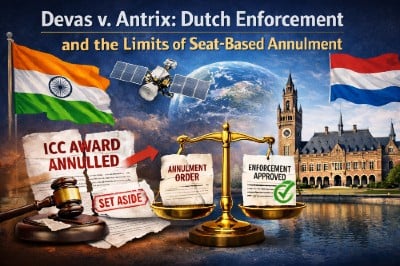
With the Dutch Supreme Court’s 6 March 2026 dismissal of Antrix’s cassation challenge, attention has once again turned to one of the most closely watched India-linked arbitration disputes in recent years. The dismissal leaves in place the Hague Court of Appeal’s 17 December 2024 judgment in Devas Multimedia America Inc. v. Antrix Corporation Ltd., permitting enforcement in the Netherlands of the ICC award arising from the Devas-Antrix dispute, even though the award had been set aside at the seat in India.
 Background
The dispute arose out of a 2005 Satellite Capacity Agreement (“Agreement”) under which Antrix, the commercial arm of the Indian Space Research Organisation, agreed to build, launch and operate satellites and lease S-band spectrum capacity on the satellites to Devas for multimedia services in India.[1] In 2011, after the Indian Government decided that the spectrum could no longer be allocated for the project, Antrix terminated the Agreement.[2]
In the ICC arbitration seated in New Delhi, the tribunal unanimously held on 14 September 2015 that Antrix had wrongfully terminated the Agreement and awarded Devas USD 562.5 million plus interest (“ICC Award”).[3]
In 2021, Antrix commenced winding up proceedings to liquidate Devas before the National Company Law Tribunal (“NCLT”) in India, alleging that Devas had been incorporated for a fraudulent and unlawful purpose and the underlying Agreement had been procured through fraud and corruption.[4] On this basis, the NCLT ordered that Devas be wound up.[5] This winding-up decision was upheld on appeal by the National Company Law Appellate Tribunal (“NCLAT”) and the Supreme Court of India.
In 2022, the Delhi High Court set aside the ICC Award for being patently illegal and contrary to Indian public policy, relying heavily on the fraud findings that had emerged in the liquidation proceedings.[6] The annulment was confirmed by the Division Bench of the Delhi High Court and the Supreme Court of India.[7]
The Devas-Antrix dispute has already generated extensive litigation across multiple jurisdictions in post-award proceedings. For a detailed discussion on other chapters of this saga, refer to our previous discussion on the proceedings before the French Court of Appeal (here) and the U.S. Supreme Court (here).
Enforcement Proceedings in the Netherlands
In 2018, Devas had entered into a Collection Services Agreement with Devas Multimedia America Inc. (“DMAI”) for the recovery of the claims arising out of the ICC Award. DMAI then pursued enforcement proceedings in the Netherlands.[8]
The issue before the Dutch courts was whether DMAI, which was not itself a party to the arbitration agreement or the award, was entitled to seek enforcement of the ICC Award in the Netherlands, considering the Indian liquidator’s attempt to withdraw DMAI’s authority to do so. The Hague District Court answered the question in the negative.[9]
The Hague Court of Appeal’s Decision
On appeal, however, the Hague Court of Appeal (“Court of Appeal”) reversed the decision and granted DMAI permission to enforce the ICC Award in the Netherlands.[10]
Non-Recognition of the Liquidation Judgment
First, the Court of Appeal closely considered whether the liquidation proceedings against Devas before the NCLT, the NCLAT and the Supreme Court of India met the minimum standards of fairness and due process required by Article 6 of the European Convention on Human Rights and Dutch legal standards.[11] It found that:
- No document production: Devas was not afforded a fair opportunity to defend itself in violation of due process requirements.[12] Antrix alleged before the Indian courts that the Agreement was withheld from relevant government agencies (in collusion with former Antrix and government officers) who were unaware of it.[13] In response, Devas requested that Antrix produce all documents relating to meetings of various government agencies on the Agreement.[14] However, the NCLAT rejected Devas’s request for document production, even though those materials could have been relevant to answering the fraud allegations.[15]
- Denial of cross-examination: Antrix alleged in the liquidation proceedings that Devas misrepresented having the technical know-how to develop and provide services. In doing so, it relied on written statements from Antrix employees.[16] The Indian courts relied on such statements without permitting Devas to cross-examine the witnesses, thus violating the right to a fair hearing.[17]
- Mischaracterisation of contested facts: In addition, the Supreme Court of India proceeded on the basis that certain core allegations of fraud were “undisputed”, even though Devas had refuted these objections in the liquidation proceedings.[18]
Against that background, the Court of Appeal concluded that the liquidation proceedings did not provide sufficient procedural safeguards and that the resulting liquidation order could not be recognised in the Netherlands. As a result, the liquidator’s powers, including its order to DMAI to cease enforcement of the ICC Award, have no effect in the Netherlands.[19]
Non-Recognition of the Annulment Judgment
The Court of Appeal then addressed Antrix’s reliance on Article V(1)(e) of the New York Convention, which permits refusal of enforcement where an award has been set aside by a competent authority at the seat. Relying on the Dutch Supreme Court’s decision in Maximov/NLMK, it reiterated that annulment at the seat is not automatically decisive and that enforcement may still be granted in exceptional circumstances, including where the foreign annulment judgment itself is not capable of recognition in the Netherlands.[20] Applying that approach, the Court of Appeal held that the Delhi High Court’s annulment judgment could not be recognised because it rested on the same fraud findings from the Indian liquidation proceedings that had already been found tainted by due process defects.[21]
The Court of Appeal also found no violation of Dutch public policy, as the alleged fraud surrounding the Agreement had not been validly established, and there was no irregularity in the constitution of the tribunal or the arbitral procedure. It held that under Indian law, the arbitration clause entitled Devas to commence ICC arbitration.[22]
Conclusion: The Broader Lesson for International Arbitration
For parties involved in international arbitrations, the Dutch developments reinforce three points.
First, annulment at the seat is highly important, but not always dispositive internationally. The Devas-Antrix case offers a current and concrete example of how that can play out in practice.
Second, due process objections do not remain confined to the jurisdiction in which they arise. Judicial findings obtained in domestic proceedings may later be scrutinised abroad when a court is asked to recognise those findings for enforcement purposes. A successful challenge at the seat may therefore still face resistance elsewhere if the surrounding proceedings are viewed as procedurally compromised. This judgment of the Court of Appeal, now left undisturbed by the Dutch Supreme Court, may encourage closer scrutiny of domestic annulment judgments elsewhere.[23] This is also a lesson for local lawyers and judges worldwide to ensure that due process requirements in domestic proceedings are satisfied.
Third, the enforcement strategy in major international arbitrations is never purely local. It must be planned across jurisdictions from the outset, taking into account likely enforcement fora, asset locations, the interaction between annulment and enforcement proceedings, and the standards different courts may apply when deciding whether to recognise foreign judgments.
[1] Court of Appeal The Hague 17 December 2024, ECLI:NL:GHDHA:2024:2384, paras. 3.4-3.5.
[2] Id. paras. 3.12, 3.13.
[3] Id. para. 3.16.
[4] Id. paras. 3.25-3.28.
[5] Id. para. 3.28.
[6] Antrix Corporation Ltd. v. Devas Multimedia Private Ltd., O.M.P. (COMM) 11/2021, Delhi High Court, 29 August 2022.
[7] Devas Employees Mauritius Pvt. Ltd. v. Antrix Corporation Ltd., 2023:DHC:1933-DB; Devas Employees Fund US LLC v. Antrix Corporation Ltd., SLP No. 22622 of 2023, Supreme Court of India, 17 March 2023.
[8] Hof The Hague 17 December 2024, ECLI:NL:GHDHA:2024:2384, para. 4.1.
[9] Id. para. 4.2.
[10] Id. para. 7.
[11] Id. paras. 6.17-6.19.
[12] Id. paras. 6.36-6.37.
[13] Id. para. 6.32.
[14] Id. para. 6.36.
[15] Id. paras. 6.36-6.37.
[16] Id. para. 6.38.
[17] Id. paras. 6.38-6.40.
[18] Id. paras. 6.41-6.43.
[19] Id. para. 6.44.
[20] Id. para. 6.47.
[21] Id. para. 6.49.
[22] Id. paras. 6.51-6.60.
[23] T. Subramanian, From Fraud to Fairness: Devas v. Antrix as Catalyst for Enhanced Judicial Scrutiny in Enforcement of Arbitral Awards, 16 September 2025, https://legalblogs.wolterskluwer.com/arbitration-blog/from-fraud-to-fairness-devas-v-antrix-as-catalyst-for-enhanced-judicial-scrutiny-in-enforcement-of-arbitral-awards/ (last accessed 20 March 2026).