Few areas of US law are as committed to enforcing private dispute resolution as the Federal Arbitration Act (“FAA”). Since its enactment in 1925, the FAA has required courts to treat written arbitration agreements as “valid, irrevocable, and enforceable,” and it has repeatedly been invoked to pre-empt state laws or judicial doctrines perceived as hostile to arbitration.[1] The modern Supreme Court has often described arbitration as a matter of contract above all else: if parties agree to arbitrate, courts must generally honour that bargain.
But that raises a threshold question that is not often confronted directly: What, exactly, counts as “arbitration” under the FAA?
Can parties label a dispute-resolution mechanism “arbitration” even if it bears little resemblance to the independent, bilateral process traditionally associated with the term? And are there limits to contractual freedom where the arbitral forum is structurally aligned with one of the disputing parties?
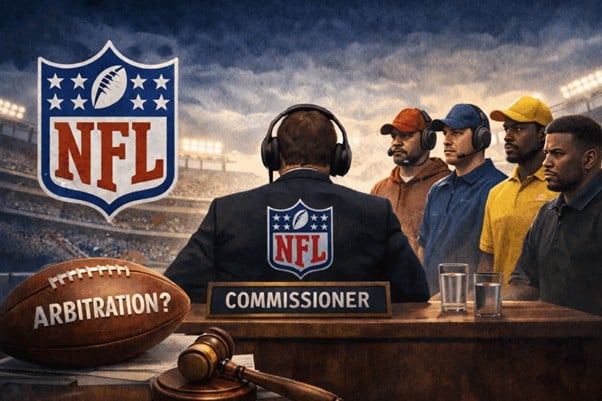
These questions are now at the centre of a high-profile challenge arising not from a commercial contract or consumer agreement, but from the internal governance regime of the National Football League (“NFL”). In Flores v. New York Football Giants, Inc., the Second Circuit refused to compel arbitration of statutory racial discrimination claims brought by NFL coach Brian Flores, holding that the NFL Constitution’s Commissioner-controlled process was “arbitration in name only” and therefore outside the FAA’s protection. The NFL has since petitioned the Supreme Court for review, warning that the decision threatens longstanding arbitration structures across professional sports and beyond.
This note examines the Second Circuit’s reasoning, the NFL’s counterarguments, and the broader implications of a potentially transformative question: when does an arbitral clause stop providing for arbitration at all?
Although the discussion below focuses on arbitration doctrine, the case arises from allegations of racial discrimination that, if proven, involve serious professional harm and deserve a fair forum for resolution; this note addresses only the threshold arbitration-law issues they present.
Background
District Court
NFL coach Brian Flores filed suit in 2022 against the NFL, the Denver Broncos, the New York Giants, and the Houston Texans, among others, as part of a putative class of current and former NFL coaches, in the federal District Court for the Southern District of New York (“District Court”), advancing claims of racial discrimination with regard to the clubs’ hiring practices under 42 U.S.C. § 1981 and other statutes.[2]
In June 2022, the NFL and the relevant member clubs moved to compel arbitration, based on Flores’s employment contracts, which incorporated by reference the NFL Constitution, which contains a broad dispute-resolution provision stating that the NFL Commissioner, who is selected and employed by the NFL, shall have “full, complete, and final jurisdiction and authority to arbitrate” disputes between various parties, including players, coaches, employees, officials and member clubs.[3]
As to Flores’s claims against the Broncos, the District Court held that the NFL Constitution’s arbitration provision applied via Flores’s contract with the Patriots (the club for which he was employed when he applied to the Broncos). However, the District Court nonetheless concluded that the provision was illusory and unenforceable under Massachusetts law because the NFL and its clubs retained unilateral authority to modify the NFL Constitution.[4]
As to Flores’s claims against the Giants and the Texans, the District Court held that the defendants had failed to establish that Flores entered into a valid arbitration agreement. The copy of Flores’s employment agreement with the Steelers, submitted to the court and purportedly operative around the time he applied to the Giants and the Texans, was not signed by the NFL Commissioner.[5]
Therefore, the District Court ordered that Flores’s claims against the Broncos, Giants, Texans and related claims against the NFL be litigated in federal court.[6]
Second Circuit
In an appeal brought by the NFL and its member clubs, decided on 14 August 2025, the U.S. Court of Appeals for the Second Circuit (“Second Circuit”) affirmed the District Court’s refusal to compel arbitration.[7] The central issue on appeal was whether the NFL Constitution’s arbitration structure could be enforced under the FAA with respect to Flores’s statutory civil rights claims.[8]
The Second Circuit began by recognising that its review of the District Court’s denial of the motion to compel arbitration was de novo and that it was “free to affirm on any ground that finds support in the record, even if it was not the ground upon which the trial court relied.”[9] This was important because it did, in fact, affirm the holding on different grounds than those relied upon by the District Court.
While recognising that Flores had agreed to the arbitration provision at issue, the Second Circuit concluded that the NFL Constitution’s dispute-resolution provision was “arbitration in name only” and therefore fell outside the FAA’s protection.[10] The Court, relying on the Supreme Court’s decision in Viking River Cruises, Inc. v. Moriana, emphasised that arbitration, as contemplated by the FAA, presumes bilateral dispute resolution.[11] Here, however, the agreement required Flores to submit his statutory claims to the unilateral substantive and procedural discretion of the NFL Commissioner, i.e., the principal executive officer of one of Flores’s adverse parties.[12] In the Court’s view, compelling a claimant to arbitrate before an individual structurally aligned with the opposing party undermined the basic independence that distinguishes arbitration from internal adjudication.[13] Importantly, because the FAA authorises federal courts to vacate arbitration awards “where there was evident partiality […] in the arbitrators”, the Court reasoned that “it would make little sense if the same statute nonetheless required the courts to compel parties to arbitrate their claims in a forum that is indisputably partial.”[14] Simply labelling such a mechanism “arbitration,” the Court explained, does not automatically bring it within the scope of the FAA.[15]
The Court also faulted the NFL Constitution for failing to provide meaningful procedural guarantees.[16] Unlike Flores’s club-specific arbitration agreements, which incorporated established dispute-resolution guidelines, the NFL Constitution contained no defined arbitral process and instead left procedural design to the Commissioner’s unilateral authority.[17] This lack of structural safeguards reinforced the Court’s conclusion that the provision bore little resemblance to “traditional arbitral practice” and could not be treated as a genuine arbitration agreement entitled to FAA deference.[18]
Even assuming the FAA applied, the Second Circuit held that the arbitration provision would still be unenforceable under the Supreme Court’s “effective vindication” doctrine.[19] That doctrine permits invalidation of arbitration agreements that operate as a prospective waiver of a party’s right to pursue statutory remedies.[20] The Court reasoned that forcing Flores to submit federal civil rights claims to a process controlled entirely by the NFL Commissioner, without an independent forum or bilateral procedural protections, failed to guarantee that Flores could meaningfully vindicate his statutory cause of action in arbitration.[21]
Finally, the Court held that because the NFL Constitution’s arbitration clause was unenforceable, it could not be used to compel arbitration of Flores’s claims against other teams, including the Giants and Texans, nor could it justify reconsideration of the district court’s denial.[22]
The Second Circuit’s decision would thus allow Flores’s discrimination claims to proceed in federal court and signal heightened judicial scrutiny of arbitration regimes that vest unilateral adjudicatory authority in the executive of one of the disputing parties, particularly where federal statutory rights are at stake.
Petition for Certiorari
In response to the Second Circuit’s decision, the New York Giants, Houston Texans, Denver Broncos and the NFL (together, the “Petitioners”) filed a petition for certiorari with the United States Supreme Court in January 2026 under the title New York Football Giants, Inc., et al., Petitioners v. Brian Flores.
The Petitioners argue that the decision is “irreconcilable with the text and history of the Arbitration Act” and “contrary to decisions from numerous other courts that have rejected arguments that the arbitration provision in the NFL Constitution, and similar provisions of other professional sports leagues, are unenforceable because they designate the league commissioner as the arbitrator.”[23]
They contend that at the time of the FAA’s enactment, arbitration had long been understood as simply “the hearing and determination of a cause between parties in controversy by a person or persons chosen by the parties […] instead of by the judicial tribunal”[24] and in the years leading up to its enactment, courts routinely enforced agreements designating arbitrators affiliated with one of the parties or one of the parties itself.[25] The Petitioners’ argument arguably elides the distinction between procedural informality and structural partiality.
The petition argues that the Second Circuit’s ruling is irreconcilable with the text, history, and settled interpretation of the FAA, which requires courts to enforce arbitration agreements “according to their terms”, including the procedures and decision-makers chosen by the parties.[26] Relying heavily on Epic Systems Corp. v. Lewis and related precedent, the petition emphasises that arbitration is fundamentally a matter of contract and that courts are not permitted to invalidate arbitration provisions based on subjective assessments of procedural fairness.[27] In the Petitioners’ view, the parties knowingly agreed that disputes would be resolved through the Commissioner’s arbitral authority, and the FAA demands enforcement of that bargain.[28]
A central theme of the petition is that the Second Circuit improperly created a novel federal doctrine by holding that the NFL Constitution provides for “arbitration in name only”.[29] Relying on its historical account of arbitration at the time of the FAA’s enactment, the petition argues that nothing in the statute requires an “independent” arbitral forum and that the Second Circuit’s approach imposes an unprecedented limitation on enforceable arbitration agreements.[30]
The petition also challenges the Second Circuit’s reliance on the effective-vindication doctrine.[31] It notes that the Supreme Court has recognised that doctrine only in narrow circumstances, such as when an agreement expressly forbids assertion of statutory rights or makes arbitration impracticable through prohibitive costs, and argues that structural concerns about the Commissioner’s role do not meet that standard.[32] According to the Petitioners, the Second Circuit’s reasoning effectively expands effective vindication into an amorphous fairness inquiry, contrary to the Supreme Court’s restrictive approach in cases like American Express Co. v. Italian Colors Restaurant.[33]
Finally, the petition stresses the broader importance of the issue, warning that the Second Circuit’s decision threatens longstanding arbitration structures used not only in the NFL but across professional sports leagues and other private organisations.[34] It argues that the ruling invites forum shopping, undermines national uniformity in FAA enforcement, and destabilises arbitration agreements that designate specialised decision-makers.[35] On that basis, the NFL contends that Supreme Court review is necessary to restore predictability and reaffirm that arbitration agreements must be enforced even when parties select unconventional arbitral procedures.[36]
Analysis
This note will now analyse the Second Circuit’s legal reasoning behind the notion that the arbitration provision in the NFL Constitution does not provide for “arbitration” as protected by the FAA, having regard to the arguments advanced in the Petitioners’ petition for certiorari. Neither the Second Circuit’s holding regarding effective vindication, nor the Petitioners’ response thereto, is analysed in this note.
To recall, a major basis of the Second Circuit’s holding that the arbitration provided for in the NFL Constitution is not arbitration at all relies heavily on Viking River, in which the Supreme Court explained that its “FAA precedents treat bilateral arbitration as the prototype of the individualized and informal form of arbitration protected from undue state interference by the FAA.”[37] The Second Circuit thus reasoned that this bilateral dispute resolution protected by the FAA necessarily requires an independent forum, which the NFL Constitution’s Commissioner-arbitrator arrangement does not provide.[38]
The Second Circuit is not the first court to point to Viking River as rendering the arbitration clause at issue outside the protections of the FAA. In Heckman v. Live Nation, for example, the Court of Appeals for the Ninth Circuit cited Viking River’s proposition that bilateral arbitration was arbitration as conceived of by Congress when it passed the FAA and therefore arbitration as protected by the FAA, in order to hold that the particular arbitration agreement at issue did not provide for “arbitration” and therefore was not covered by the FAA.[39]
However, Heckman concerned an arbitration provision that mandated mass arbitration, where many different plaintiffs would be forced to participate in class-wide arbitration procedures. Viking River specifically recalled prior precedent such as AT&T Mobility LLC v. Concepcion and Stolt-Nielsen S.A. v. AnimalFeeds Int’l Corp., which put class-action arbitration in opposition to “bilateral” arbitration, which it specified was the “individualized and informal mode of arbitration contemplated by the FAA.”[40]
The Petitioners point out that “in Viking River, the Court said nothing about a requirement that arbitrators must be independent from the parties in order for a dispute-resolution procedure to qualify as ‘arbitration,’ particularly where the parties have knowingly and voluntarily agreed to a specific default arbitrator.”[41] This is true.
While the Court in Viking River rejected the idea that “bilateral” meant two and only two parties (it found that certain representative actions were permitted), it only discussed the parties participating in the arbitration and their effect on the “bilateral” nature of the proceedings – not the arbitrator.[42]
Thus, from the Viking River precedent relied on heavily by the Second Circuit, where “bilateral” arbitration is put in opposition with collective or class arbitration, this term seems to refer to the parties involved in the arbitration, having no regard to the affiliations of the arbitrator.
The Second Circuit nonetheless argues that the “bilateral” arbitration protected by the FAA necessarily requires an “independent forum” and cites to cases where the Supreme Court has referred separately to both the parties and the arbitral panel, such as Gilmer v. Interstate/Johnson Lane Corp. and Mitsubishi Motors.[43] While the Petitioners do not touch on this argument in their petition, it is unlikely to carry much weight by itself. Simply referring to parties and arbitrators as separate entities is likely descriptively unavoidable in adjudicatory language; a court cannot explain arbitration without distinguishing between the disputants and the decision-maker. But that linguistic separation is unlikely without more to establish a legal requirement of independence as a matter of FAA doctrine.
The Second Circuit then argues that because “the Supreme Court has explained that ‘an arbitrator derives his or her powers from the parties’ agreement to forgo the legal process and submit their disputes to private dispute resolution”, an arbitration agreement that prevents parties from submitting their disputes to an independent arbitral forum “is an agreement for arbitration in name only.”[44] However, this quote does not seem to lend any further support to the Second Circuit’s point, as it again does not refer to the independence of the arbitrator, but simply recalls that it is the parties’ agreement that makes arbitration possible – and, as the Second Circuit itself recognised, Flores agreed to arbitrate his claims.[45]
The Second Circuit’s observation that it would make little sense to compel parties to arbitrate their claims in a forum that is indisputably partial carries some intuitive appeal in support of the suggested independence requirement, particularly when viewed alongside FAA § 10(a)(2). That provision expressly authorises federal courts to vacate arbitration awards “where there was evident partiality […] in the arbitrators”, suggesting that the statute itself contemplates judicial oversight as a backstop against biased decision-making.[46]
However, the force of that reasoning may be more limited than it first appears. As the Petitioners point out, federal courts have recognised that the FAA does not authorise a judge to scrutinise an arbitrator’s bias or partiality until the arbitrator has issued the award.[47] That constraint is reflected in the Second Circuit’s own precedent.
In Aviall, Inc. v. Ryder System, Inc., for example, the Second Circuit held that “[a]lthough the FAA provides that a court can vacate an award ‘[w]here there was evident partiality or corruption in the arbitrators,’ it does not provide for pre-award removal of an arbitrator.”[48] Section 10(a)(2) thus operates only retrospectively. It provides a basis for vacatur once the arbitration has run its course, but it does not obviously empower courts to intervene at the outset to prevent arbitration from proceeding before a potentially biased decision-maker.
Finally, the Second Circuit held that the arbitration agreement is likewise not protected under the FAA because (again quoting Viking River) it “fails to provide ‘the procedure to be used in resolving the dispute.’”[49] The Second Circuit’s reliance on Viking River’s reference to a “procedure to be used in resolving the dispute” is difficult to reconcile with Supreme Court precedent, which has recognised that arbitration agreements often confer broad procedural discretion (within certain limits) on the arbitrator.[50] It is therefore questionable whether, based on FAA precedent, an agreement that designates a decision-maker and obliges the parties to submit disputes, even if it leaves procedural design largely to that decision-maker, is thereby stripped of its character as “arbitration” within the meaning of the FAA.
At the same time, the Second Circuit’s concern is not entirely without force. Where an agreement imposes no obligation to hold a hearing, no duty to receive or consider evidence, and no requirement to afford the parties any adversarial process, the resulting mechanism may begin to resemble unilateral decision-making rather than adjudication. If the concept of “bilateral” arbitration were stretched beyond party configuration to encompass minimum structural features of the decision-maker’s role, the absence of such procedural commitments could support the view that the provision falls outside the core of what the FAA protects. The difficulty, however, lies in identifying a doctrinal basis in existing Supreme Court precedent for transforming that concern into a threshold definitional exclusion rather than a matter of enforceability or post-award review.
It will therefore be particularly interesting to see how the Supreme Court, if it grants certiorari, treats the pre-1925 authorities relied upon by the Petitioners. While certain of those cases do reflect a historically flexible understanding of arbitration,[50] others appear to involve arrangements in which each party selected a member of a panel, even if those appointees were affiliated with the selecting party.[51] That structure is not obviously equivalent to vesting unilateral adjudicatory authority in the executive officer of one of the disputants. The historical record may thus be more nuanced than the Petitioners’ framing suggests, and the weight the Court assigns to those authorities could prove pivotal in determining whether the NFL Constitution’s mechanism falls within the FAA’s original conception of arbitration.
Thus, while the Second Circuit’s reasoning may sit uneasily with the Supreme Court’s historically expansive conception of arbitration under the FAA, its insistence that arbitration presupposes at least some measure of structural neutrality reflects a concern that is difficult to dismiss. Whether that concern is sufficient to justify the Second Circuit’s definitional approach, however, is precisely what the Supreme Court may soon be asked to decide.
Potential Outcomes
However, before any such decision is taken by the Supreme Court, given the fact that the Supreme Court is not obliged to hear cases for which petitions are submitted to it, and, in fact, declines to do so in the majority of cases unless the case will resolve an important question of federal law or resolve a split between the circuits,[52] there is also a question as to whether it will decide to do so.
Flores seems to have great potential for injecting more fairness into arbitration practice under the FAA across the United States, at least for statutory discrimination cases. Risman & Risman hail the Second Circuit’s decision as offering “more than hope” for employees. They state that Flores “stands as a potent reminder: no arbitrary system, even if labeled ‘arbitration,’ can be enforced if it’s stacked against the person seeking justice” because it rejected situations where an employee experiences workplace discrimination, only to be told that their only remedy is through an arbitration set up by the person they are accusing.[53]
However, in this context, Mike Florio of NBC Sports points out that the NFL “wisely” limited the question presented to the Supreme Court to “whether an arbitration agreement governing disputes in a professional sports league is categorically unenforceable under the Arbitration Act because it designates the league commissioner as the default arbitrator and permits the commissioner to develop arbitral procedures”,[54] given that “the reasoning (if applied throughout corporate America) would empower other companies to attempt to rig the in-house arbitration process by putting employment disputes in the hands of the CEO.”[55]
This takes pressure off the Supreme Court if it were to decide in favour of the NFL; however, it also likely diminishes the appeal of the case for the Supreme Court, as the effect of any decision would therefore be limited.
However, Anthony Del Giudice, Michael Woodson and Kamryn Alexander of Eversheds Sutherland point out that “various pro sports leagues vest great control with league leadership to oversee non-public dispute resolution proceedings and keep such matters out of court”, recalling that Major League Baseball’s constitution features a similar provision that gives its Commissioner broad powers as arbitrator.[56]
Mr. Christopher Deubert of Constangy, Brooks, Smith & Prophete reminds that while the “NFL’s petition may seem too industry-specific to warrant Supreme Court review”, “the Court has previously taken cases whose applicability was largely limited to professional sports”, citing the 1996 case Brown v. Pro Football, Inc.[57]
It is also questionable whether the Supreme Court will be convinced that there is a concrete circuit split that needs to be resolved. While the Petitioners mention cases from other circuits in which awards rendered by the NFL Commissioner were upheld, the Supreme Court may not be satisfied that these cases truly are split on the same question of law as the present case. For example, in Williams v. NFL[58] and NFL Players Association ex rel. Peterson v. NFL,[59] the Eighth Circuit reviewed a Commissioner-issued award under FAA § 10 after arbitration had concluded, rather than considering, at the motion-to-compel stage, whether an arbitration clause designating the Commissioner as arbitrator is enforceable (or even qualifies as “arbitration”) in the first place. Those cases also arose from player disputes governed by a collective bargaining agreement (“CBA”), whereas Flores concerns statutory discrimination claims by a coach and the enforceability of the NFL Constitution’s dispute-resolution mechanism outside the player CBA framework. Consistent with that distinction, the Second Circuit in Flores emphasised that its holding did not call into question its earlier decision upholding the Commissioner’s authority in a player-related matter.[60] For these reasons, the Petitioners’ authorities may be framed as illustrating different applications of FAA review in the CBA context, rather than a direct conflict on the specific threshold question presented in Flores.
Following a motion to extend the time to file a response filed by Flores, the time for Flores to submit a response is now 6 March 2026.[61] This means that the Supreme Court will not likely decide whether to grant the NFL’s petition until at least April 2026. This will certainly be a case to watch.
Conclusion
Whether the Supreme Court ultimately grants certiorari in Flores remains uncertain. The case arises from a professional sports league’s internal constitution, and the Court may be reluctant to intervene in what could be characterised as an industry-specific dispute. At the same time, the question presented goes well beyond football. At its core lies a foundational issue of federal arbitration law: whether the FAA’s command to enforce arbitration agreements “according to their terms” extends even to mechanisms that vest unilateral adjudicatory power in an individual structurally aligned with one of the parties.
The Second Circuit’s decision is striking not because it applies a familiar contract defence, but because it suggests a threshold limitation on what qualifies as “arbitration” in the first place. By holding that the NFL Constitution provides for “arbitration in name only”, the Court implied that FAA protection presupposes at least a minimally independent forum and some basic procedural structure. That reasoning carries intuitive force, particularly where statutory civil rights claims are at stake, and where the decision-maker is the executive officer of the opposing party. Yet it also sits uneasily with the historical understanding of arbitration at the time of the FAA’s enactment, and with the Supreme Court’s repeated insistence that arbitration is, above all, a matter of consent and contract.
If the Court takes up the case, it may be forced to confront a difficult boundary question: does the FAA merely require courts to enforce whatever process the parties have labelled “arbitration,” or does the statute contain an implicit concept of arbitration that excludes arrangements so structurally one-sided that they resemble internal adjudication rather than neutral dispute resolution?
The answer will shape not only the future of dispute resolution under the NFL Constitution, but also the extent to which private organisations may design arbitral regimes that concentrate procedural and substantive authority in the hands of a single interested decision-maker. For now, Flores stands as a judicial signal that there may be limits to how far the label of arbitration can stretch.
The Supreme Court must now decide whether to let the Second Circuit’s ruling stand, allowing the game to continue in the lower courts, or whether to step in and determine once and for all what counts as arbitration under the FAA. Either way, the decision could prove to be more than a dispute about professional football. It may become a defining moment in the ongoing struggle over the meaning, legitimacy, and future boundaries of American arbitration law.
Aceris Law advises clients in international arbitration and sports-related dispute resolution, including matters involving arbitral procedure, institutional authority, and challenges to the enforceability of arbitration agreements.
[1] B. Adkins, The Federal Arbitration Act and Class Action Waivers, 13 September 2024, https://www.congress.gov/crs-product/IF12764 (last accessed 12 February 2026).
[2] Flores v. New York Football Giants, Inc., 150 F.4th 172 (2d Cir. 2025), pp. 7-8. The case also included claims against the coaches’ respective employer clubs for discrimination experienced during their employment; however, the District Court ruled that these claims should be decided by arbitration on the basis of the coaches’ employment contracts, and therefore, these claims are not discussed in this note.
[3] NFL Constitution and Bylaws, Section 8.3; Flores v. New York Football Giants, Inc., 150 F.4th 172 (2d Cir. 2025), p. 8.
[4] Flores v. New York Football Giants, Inc., 150 F.4th 172 (2d Cir. 2025), pp. 9-11.
[5] Ibid., pp. 11-12.
[6] Ibid., p. 12.
[7] Ibid., p. 5.
[8] Ibid.
[9] Ibid., pp. 13-14.
[10] Ibid., pp. 19-21.
[11] Ibid., pp. 20-21.
[12] Ibid.
[13] Ibid.
[14] Ibid., p. 21.
[15] Ibid., p. 22.
[16] Ibid., p. 23.
[17] Ibid.
[18] Ibid., p. 24.
[19] Ibid., pp. 25-27.
[20] Ibid., p. 25.
[21] Ibid., pp. 26-27.
[22] Ibid., pp. 27-28.
[23] New York Football Giants, Inc., et al., Petitioners v. Brian Flores, petition for cert. filed (6 Jan. 2026) (No. 25-790), pp. 3-4.
[24] Ibid., p. 11.
[25] Ibid., pp. 12-13.
[26] Ibid., pp. 9-10.
[27] Ibid., pp. 10-11.
[28] Ibid., p. 11.
[29] Ibid.
[30] Ibid., pp. 12-17.
[31] Ibid., pp. 17-18.
[32] Ibid., p. 18.
[33] Ibid.
[34] Ibid., pp. 19-20.
[35] Ibid., pp. 23-24.
[36] Ibid., p. 25.
[37] Flores v. New York Football Giants, Inc., 150 F.4th 172 (2d Cir. 2025), p. 14.
[38] Ibid., p. 20.
[39] Heckman v. Live Nation Ent., Inc., 120 F.4th 670, 691 (9th Cir. 2024), cert. denied, 146 S. Ct. 96 (2025).
[40] Viking River Cruises, Inc. v. Moriana, 596 U.S. 639, 142 S. Ct. 1906, 213 L. Ed. 2d 179 (2022), p. 9.
[41] New York Football Giants, Inc., et al., Petitioners v. Brian Flores, petition for cert. filed (6 Jan. 2026) (No. 25-790), p. 15.
[42] Viking River Cruises, Inc. v. Moriana, 596 U.S. 639, 142 S. Ct. 1906, 213 L. Ed. 2d 179 (2022).
[43] Flores v. New York Football Giants, Inc., 150 F.4th 172 (2d Cir. 2025), fn. 51.
[44] Ibid., p. 21.
[45] Ibid., pp. 17-18.
[46] Ibid., p. 21.
[47] New York Football Giants, Inc., et al., Petitioners v. Brian Flores, petition for cert. filed (6 Jan. 2026) (No. 25-790), p. 16.
[48] Aviall, Inc. v. Ryder System, Inc., 110 F.3d 892 (2d Cir. 1997).
[49] Flores v. New York Football Giants, Inc., 150 F.4th 172 (2d Cir. 2025), p. 22.
[50] “In certain contexts, it is appropriate to presume that parties that enter into an arbitration agreement implicitly authorize the arbitrator to adopt such procedures as are necessary to give effect to the parties’ agreement. Thus, we have said that “ ‘ “procedural” questions which grow out of the dispute and bear on its final disposition’ are presumptively not for the judge, but for an arbitrator, to decide.” Howsam v. Dean Witter Reynolds, Inc., 537 U. S. 79, 84 (2002) (quoting John Wiley & Sons, Inc. v. Livingston, 376 U. S. 543, 557 (1964)). This recognition is grounded in the background principle that “[w]hen the parties to a bargain sufficiently defined to be a contract have not agreed with respect to a term which is essential to a determination of their rights and duties, a term which is reasonable in the circumstances is supplied by the court.” Restatement (Second) of Contracts §204 (1979).” Stolt-Nielsen S. A. v. AnimalFeeds Int’l Corp., 559 U.S. 662 (2010) (holding, however, that class arbitration was not within the limits of such a presumption).
[50] See, e.g., Commonwealth v. Eastern Paving Co., 8 Pa. D. & C. 357, 361-362 (Com. Pl. 1926) (discussing cases), aff’d, 136 A. 853 (Pa. 1927).
[51] See, e.g., Duvall v. Sulzner, 155 F. 910, 918-919 (C.C.W.D. Pa. 1907).
[52] Supreme Court Procedures, https://www.uscourts.gov/about-federal-courts/educational-resources/about-educational-outreach/activity-resources/supreme-court-procedures (last accessed 12 February 2026).
[53] When the System Picks the Referee: What the Second Circuit’s Flores v. NFL Decision Means for Employees Everywhere, 19 August 2025, https://www.risman-law.com/2025/08/19/when-the-system-picks-the-referee-what-the-second-circuits-flores-v-nfl-decision-means-for-employees-everywhere/ (last accessed 12 February 2026).
[54] New York Football Giants, Inc., et al., Petitioners v. Brian Flores, petition for cert. filed (6 Jan. 2026) (No. 25-790), p. 3.
[55] M. Florio, NFL takes Brian Flores case to Supreme Court on issue of arbitration, 8 January 2026, https://www.nbcsports.com/nfl/profootballtalk/rumor-mill/news/nfl-takes-brian-flores-case-to-supreme-court-on-issue-of-arbitration (last accessed 12 February 2026).
[56] A. Del Giudice et al., NFL arbitration provision ruling has ramifications for other leagues, 16 October 2025, https://www.sportsbusinessjournal.com/Articles/2025/10/16/nfl-arbitration-provision-ruling-has-ramifications-for-other-leagues/ (last accessed 12 February 2026).
[57] C. Deubert, NFL throws Hail Mary to Supreme Court on Commissioner arbitral authority, 13 January 2026, https://www.constangy.com/employment-labor-insider/nfl-throws-hail-mary-to-supreme-court-on-commissioner-arbitral-authority (last accessed 12 February 2026).
[58] Williams v. NFL, 582 F.3d 863 (8th Cir. 2009), cert. denied, 562 U.S. 1029 (2010).
[59] NFL Players Association ex rel. Peterson v. NFL, 831 F.3d 985 (8th Cir. 2016).
[60] C. Deubert, NFL throws Hail Mary to Supreme Court on Commissioner arbitral authority, 13 January 2026, https://www.constangy.com/employment-labor-insider/nfl-throws-hail-mary-to-supreme-court-on-commissioner-arbitral-authority (last accessed 12 February 2026).
[61] Supreme Court Docket No. 25-790, https://www.supremecourt.gov/search.aspx?filename=/docket/docketfiles/html/public/25-790.html (last accessed 12 February 2026).