This note deals with the current legal framework of investor-State arbitration under the Energy Charter Treaty (the “ECT”). The landscape of the application of the ECT has become blurry after several major developments in recent years: withdrawals, modernisation of the ECT, not to mention the impact of the Komstroy decision,[1] which has by no means been uniformly welcomed by arbitral tribunals. Hence, the question is, where do investors stand today with respect to claims under the ECT? The answer is not straightforward in view of this fragmented legal framework.
This note is structured as follows: first, it provides a brief overview of the stages through which the ECT has been called into question; second, it examines the content of the modernised ECT, including its entry-into-force regime and substantive amendments; then, it analyses the European perspective before discussing the adoption of model inter se agreements and their attempt to neutralise the Sunset Clause, and finally turns to the current arbitration landscape.
I. Brief Overview of the Stages in the Calling into Question of the ECT
The European Union (the “EU”) was a contracting party to the ECT (a “Contracting Party” or “Contracting Parties”), together with the European Atomic Energy Community (the “Euratom”) and the EU Member States, as well as Switzerland, Japan, Turkey and most countries from the Western Balkans and the former USSR.[2]
On 30 May 2024, both the EU and the Euratom formally withdrew from the ECT.[3] The withdrawal took effect on 28 June 2025.[4] To recall, Russia was among the first Contracting Parties to withdraw from the ECT along with Italy.[5] Other States then followed. In parallel to these withdrawals, on 3 December 2024, the Contracting Parties to the ECT approved the adoption of a long-awaited modernised version of the treaty (the “Modernised ECT”).[6] This outcome followed a protracted reform process. In fact, discussions around the ECT’s modernisation had already begun in November 2017.[7] It was specifically the slow pace of negotiations that led several Contracting Parties to withdraw from the ECT, including France, Germany, Poland, Luxembourg, Slovenia, Portugal, Denmark, and the United Kingdom, among others.[8]
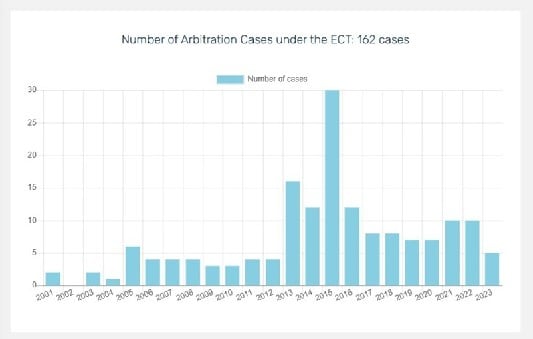
As is now largely known, the ECT attracted considerable criticism from civil society and activists, who argued that the treaty hindered efforts to combat climate change.[9] Contracting Parties also saw their ability to implement public interest measures, such as environmental and energy transition policies, highly restricted as they were systematically faced with claims by investors.[10] The EU described the ECT as “one of the most litigated investment treaties in the world”.[11] In fact, there were 162 investment arbitration cases under the ECT as of December 2023, as demonstrated in the chart below:[12]
About 70% of them were intra-EU investment arbitration cases.[13] In addition, the protection of investments in fossil energy sources like oil, gas and coal, was incompatible with the EU’s climate policies, especially the European Green Deal and the Paris Agreement.[14] Finally, the EU’s position in Komstroy that the investor-State dispute settlement mechanism under the ECT was incompatible with EU law and thus not applicable to intra-EU disputes came as the “cherry on top” of this already turbulent landscape.
II. The Content of the Modernised ECT
1. The Complexity of the Provisions on the Entry Into Force of the Modernised ECT
The “Amendments to the Energy Charter Treaty” were adopted by a decision of the Energy Charter Conference dated 3 December 2024 (the “Amendments to the ECT”).[15] According to Article 11 of this decision, the amendments apply provisionally and enter into force in accordance with another decision adopted by the Energy Charter Conference on the same day (the “2024 Entry Into Force Provisions”).[16]
Article (1)(a) of the 2024 Entry Into Force Provisions provides that “[t]he amendments to the Energy Charter Treaty (ECT) adopted on 3 December 2024 shall enter into force in accordance with Article 42(4) of the ECT.” Article 42(4) of the ECT itself provides that the Amendments to the ECT enter into force on the ninetieth day after at least three-fourths of the Contracting Parties have submitted their instruments of ratification, acceptance, or approval to the ECT Depositary but only with respect to the Contracting Parties that have ratified, accepted, or approved them. For the remaining parties, the amendments enter into force on the ninetieth day after those parties have deposited their instrument of ratification, acceptance or approval of the amendments.
Clause (1)(b) of the 2024 Entry Into Force Provisions then stipulates that two revisions to the ECT enter into force on 3 September 2025. These are set out in new Sections A and B of Annex NI of yet another decision of the Energy Charter Conference dated 3 December 2024,[17] and concern the exclusion of some fossil fuel investments from ECT protection. These revisions do not apply to ISDS disputes under the ECT submitted prior to 3 September 2025.
Section A excludes specified fuels “in relation to all Contracting Parties”.[18] Unlike Section B, however, Section A does not contain explicit temporal language clarifying whether it applies to investments made prior to 3 September 2025 or only to those made after that date.
As for Section B of Annex NI, it provides that, from 3 September 2025, new investments in the EU and its Member States relating to coal, gas, oil, electrical energy and certain high-carbon fuels will no longer benefit from protection under the ECT.[19]
Section C provides that investments made before 3 September 2025 in the EU will continue to benefit from ECT protection for up to ten years after Section C enters into force, but protection will end no later than 31 December 2040.[20]
Pursuant to Clause (2) of the 2024 Entry Into Force Provisions, as from 3 September 2025, each Contracting Party agrees to apply provisionally the Amendments to the ECT adopted on 3 December 2024, including Section C of Annex NI and the related Annex modifications, pending their formal entry into force. However, the 2024 Entry Into Force Provisions also gave the possibility for any Contracting Party to notify the Depositary, before 3 March 2025, that it would not accept the provisional application of the Amendments to the ECT and related Annex changes. Such declarations can be withdrawn at any time.[21] Finally, a Contracting Party may also end its provisional application of the amendments by notifying the Depositary that it does not intend to ratify them. The termination takes effect 60 days after the notification is received.[22]
Many Contracting Parties have not accepted the provisional application of the Amendments to the ECT. Among them are the Czech Republic, Finland, Switzerland and Belgium.[23] The following Contracting Parties should have begun provisionally applying the Amendments to the ECT from 3 September 2025: Afghanistan, Albania, Armenia, Azerbaijan, Bosnia and Herzegovina, Bulgaria, Croatia, Cyprus, Georgia, Greece, Hungary, Iceland, Ireland, Jordan, Kazakhstan, Kyrgyzstan, Malta, Moldova, Mongolia, Montenegro, North Macedonia, Romania, Slovakia, Sweden, Tajikistan, Türkiye, Turkmenistan, Ukraine, Uzbekistan, and Yemen.[24]
2. Main Substantive Amendments
The amendments adopted on 3 December 2024 modernise the ECT by strengthening references to sustainable development,[25] climate action and labour standards[26] in the Preamble and by expressly reaffirming States’ right to regulate.[27]
They clarify and narrow key definitions, including “investment,”[28] “investor”, and introduce a “substantial business activities” requirement.[29] From now on, protection does not include natural person investors who are residents of, or hold the nationality of, “the host Contracting Party at the time the investment was made or acquired”.[30] The fair and equitable treatment standard is codified through an exhaustive list of breaches,[31] full protection and security is limited to physical security,[32] and detailed guidance is provided on direct and indirect expropriation, confirming that bona fide public policy measures, including climate measures, generally do not amount to indirect expropriation.[33]
The amendments also introduce an intra-EU carve-out, providing that the ECT’s dispute resolution and related provisions do not apply between Contracting Parties that are members of the same Regional Economic Integration Organisation (“REIO”), such as between EU Member States,[34] thus consolidating the Court of Justice of the European Union’s position in Komstroy.
The amendments, however, left untouched the so-called “sunset clause” (the “Sunset Clause”) of Article 47(3) of the ECT, pursuant to which investments made prior to a Contracting Party’s withdrawal remain protected for an additional 20 years.
III. The EU’s Position on Intra-EU Arbitration under the ECT
On 26 June 2024, the representatives of the governments of the Member States and of the EU, relying, inter alia, on the Achmea[35] and Komstroy[36] decisions, issued a declaration expressing “the common understanding” of the signatories “on the interpretation and application of the Energy Charter Treaty, according to which Article 26 of that Treaty cannot and never could serve as a legal basis for intra-EU arbitration proceedings” and that, “as a result of the absence of legal basis for intra-EU arbitration proceedings pursuant to Article 26 of the Energy Charter Treaty, Article 47(3) of the Energy Charter Treaty cannot extend, and could not have been extended, to such proceedings” (the “2024 EU Declaration”).[37] However, as this remains a purely political statement, it is uncertain whether it produces any legal effect under public international law.[38]
The European Commission also called for the adoption of an international agreement by the EU, Euratom and the Member States in line with this declaration.[39] The European Economic and Social Committee, in turn, called for the adoption of a mechanism in order to neutralise the effects of the ECT’s 20-year survival clause and also invited the Member States still Contracting Parties to the ECT to consider withdrawing from it.[40]
IV. Model Inter Se Agreements to Neutralise the Sunset Clause
In August 2024, the International Institute for Sustainable Development published a Model Inter Se Agreement aimed at neutralising the effects of the Sunset Clause between the EU and its Member States, on the one hand, and non-EU Contracting Parties, on the other, setting out the conditions under which such an agreement would comply with the Law of Treaties.[41]
Article 2, called “Inter Se Modification” expressly provides that “[a]s between the Contracting Parties, Article 47, paragraph 3 of the Energy Charter Treaty, as provided below, shall be deleted” and that Article 26 of the ECT does not apply to disputes between Contracting Parties, where either the respondent or the home jurisdiction of the investor, or both, have withdrawn from the Energy Charter Treaty.[42]
On 10 September 2025, the European Parliament and the Council of the EU then adopted “Decision (EU) 2025/1904 of the European Parliament and of the Council on the Approval by the Union of the Agreement on the interpretation and application of the Energy Charter Treaty” accompanied by the final text of an inter-se international “Agreement on the Interpretation and Application of the Energy Charter Treaty” (the “EU Inter Se Agreement”).[43] The adopted text broadly reflects the content of the 2024 EU Declaration. The text of the agreement in addition explicitly excludes the possibility for parties to make reservations (Article 4 of the agreement). It also specifies that it will enter into force 30 days after receipt of the second instrument of ratification, approval, or acceptance (Article 6.1 of the agreement) and for the other parties, 30 calendar days after the date of deposit by such parties of their instrument of ratification, approval or acceptance (Article 6.2 of the agreement). To date, there is no indication that two instruments have already been deposited. On that basis, the agreement should not yet be in force; only the approving decision is in force (Article 2 of the decision).
V. Current Arbitration Landscape Under the ECT
It seems that to date, immediate arbitration exposure under the ECT has not fundamentally shifted following the adoption of the Amendments to the ECT, given the fragmented and protracted process governing their entry into force. Similarly, the EU’s and other Contracting Parties’ withdrawals from the Treaty have not, in practice, significantly reduced arbitration exposure. This is due, first, to the continued operation of the Sunset Clause, which sustains so-called “legacy arbitrations”,[44] and second, to the uneven reception of the Komstroy judgment by arbitral tribunals. Indeed, a number of tribunals continue to assert jurisdiction in intra-EU disputes, while award creditors are simultaneously seeking enforcement of intra-EU awards in third countries where EU Member States hold assets.[45] It remains, therefore, to be seen how the EU Inter Se Agreement will be received by tribunals once entered into force.
Recently, the Singapore International Commercial Court of the Singapore High Court (the “SICC”) upheld a £183 million ECT award against Poland, despite Poland’s “intra-EU objection”.[46] The award was rendered in favour of two UK subsidiaries of the Australian mining company GreenX Metals.[47] While the UK had already ceased to be a member of the EU by the time the claim was brought in September 2020, Poland argued that EU law continued to apply in the UK during the transition period, which ended only on 31 December 2020.[48] The SICC, however, considered that any intra-EU objection would no longer apply to arbitration proceedings initiated by the UK investors after 1 January 2021.[49] Therefore, even if the award were set aside, this would not prevent the investors from resubmitting their claims.[50] More importantly, the SICC found that Article 26 did apply to intra-EU disputes.[51] It noted that Article 16 of the ECT, dealing with conflicts between the ECT and other treaties gives priority to the provision that is more favourable to investors, thus, here, Article 26 against EU law.[52]
ExxonMobil v. Netherlands is yet another intra-EU dispute under the ECT that was introduced in September 2024, i.e., after the 2024 EU Declaration. It involves the Belgian subsidiary of ExxonMobil and the Netherlands, concerning the investor’s investment in the Groningen gas field, jointly operated with Shell through a joint venture.[53] The case remains pending.
Further, an ICSID tribunal has been constituted in ArcelorMittal v. Italy under the ECT.[54] The case concerns the Luxembourg-based steel giant, ArcelorMittal and its 2 billion euros investment in the local steel company Acciaierie d’Italia within a public-private partnership with the Italian State. As another intra-EU dispute, it will be particularly interesting to see how the tribunal rules on its jurisdiction.
Conclusion
As of today, the ECT operates at different speeds:
- first, Contracting Parties that have withdrawn from the ECT remain subject to the pre-modernisation version of the ECT for the duration of the 20-year Sunset Clause;
- second, for Contracting Parties that remain members of the ECT but have opted out of provisional application of the amendments, the previous version of the ECT continues to apply until they ratify, accept or approve the amendments, with the exception of Sections A and B of Annex NI, which entered into force on 3 September 2025;
- third, for Contracting Parties that did not opt out of provisional application, the revised framework applies in full, subject to their right to terminate provisional application;
- fourth, for EU Member States specifically, the same applies with the particularity that they have now adopted the EU Inter Se Agreement, whose impact and reception by arbitral tribunals will have to be carefully scrutinised.
In the words of an author, “[t]his leads to a patchwork of coverage where different treaty standards apply simultaneously both within and outside the EU”,[55] which creates a fragmented and unpredictable landscape for investors. The overall result is a multilayered and complex regime in which investors’ rights and States’ exposure depend heavily on timing, geography and the specific constellation of applicable treaty commitments.
Aceris Law acts as counsel for both investors and States in arbitrations under the Energy Charter Treaty.
[1] Judgment of 2 September 2021, Republic of Moldova v Komstroy LLC, Case C-741/19, EU:C:2021:655.
[2] European Commission, Proposal for a Council Decision on the Withdrawal of the Union from the Energy Charter Treaty, COM(2023) 447 final, 7 July 2023, para. 2.1.
[3] Council Decision (EU) 2024/1644 of 30 May 2024, Decision on the Position to Be Taken On Behalf of the European Union in the Energy Charter Conference, OJ L, 6 June 2024; Council Decision (EU) 2024/1677 of 30 May 2024, Decision on the Approval of the Withdrawal of the European Atomic Energy Community from the Energy Charter Treaty, OJ L, 13 June 2024.
[4] L. Schaugg, Why Coordinated Withdrawal From the Energy Charter Treaty Remains Essential for Effective Climate Action, 30 June 2025, https://www.iisd.org/articles/insight/coordinated-energy-charter-treaty-withdrawal-essential (last accessed 3 March 2026).
[5] Both States withdrew respectively in 2009 and 2016: I. Trouyet and A. L. Namdar, Exodus From The Energy Charter Treaty – What is Left of Europe’s Protections for Investors?, 16 January 2024, Proskauer.
[6] Energy Charter Conference, Decision CCDEC 2024 12 GEN of 3 December 2024, Subject: Amendments to the Energy Charter Treaty.
[7] I. Trouyet and A. L. Namdar, Exodus From The Energy Charter Treaty – What is Left of Europe’s Protections for Investors?, 16 January 2024, Proskauer.
[8] M. Coleman et al., Energy Charter Treaty 2.0 – Changes as of 3 September 2025, updated 30 September 2025, Steptoe.
[9] C. Baldon and R. Craveia, Overview of Recent Fossil Fuel Arbitration Cases Under the Energy Charter Treaty – Investment Treaty News, 27 January 2025, https://www.iisd.org/itn/2025/01/27/overview-recent-fossil-fuel-arbitration-cases-under-energy-charter-treaty-clementine-baldon-rosanne-craveia/ (last accessed 3 March 2026).
[10] European Commission, Proposal for a Council Decision on the Withdrawal of the Union from the Energy Charter Treaty, COM(2023) 447 final, 7 July 2023, para. 2.2.
[11] Id. para. 2.2.
[12] Energy Charter Treaty, Statistics, updated 1 December 2023, https://www.energychartertreaty.org/cases/statistics/ (last accessed, 3 March 2026).
[13] European Economic and Social Committee, Opinion REX/593, Decision on the Interpretation and Application of the Energy Charter Treaty, 4 December 2024.
[14] Id. para. 1.5.
[15] Energy Charter Conference, Decision CCDEC 2024 12 GEN of 3 December 2024, Subject: Amendments to the Energy Charter Treaty.
[16] Energy Charter Conference, Decision CCDEC 2024 12 GEN of 3 December 2024, Subject: Amendments to the Energy Charter Treaty, Article 11; Energy Charter Conference, Decision CCDEC 2024 15 GEN of 3 December 2024, Subject: Entry into Force and Provisional Application of Amendments to the Energy Charter Treaty and Changes and Modifications to its Annexes.
[17] Energy Charter Conference, Decision CCDEC 2024 13 GEN of 3 December 2024, Subject: Modifications and Changes to Annexes to the Energy Charter Treaty.
[18] Id. Section A.
[19] Id. Section B.
[20] Id. Section C.
[21] Energy Charter Conference, Decision CCDEC 2024 15 GEN of 3 December 2024, Subject: Entry into Force and Provisional Application of Amendments to the Energy Charter Treaty and Changes and Modifications to its Annexes, Clause (3)(a).
[22] Id. Clause (4).
[23] M. Coleman et al., Energy Charter Treaty 2.0 – Changes as of 3 September 2025, updated 30 September 2025, Steptoe.
[24] Id.
[25] Energy Charter Conference, Decision CCDEC 2024 12 GEN of 3 December 2024, Subject: Amendments to the Energy Charter Treaty, Article 1.2.
[26] Id. Article 2.12.
[27] Id. Article 4.19.
[28] Id. Article 2.8.
[29] Id. Article 2.9.
[30] Id. Article 2.9.
[31] Id. Article 4.2.
[32] Id. Article 4.2.
[33] Id. Article 4.14.
[34] Id. Article 5.12.
[35] Judgment of 6 March 2018, Slovak Republic v Achmea BV, Case C-284/16, EU:C:2018:158.
[36] Judgment of 2 September 2021, Republic of Moldova v Komstroy LLC, Case C-741/19, EU:C:2021:655.
[37] Representatives of the Governments of the Member States and of the European Union, Declaration on the Legal Consequences of the Judgment of the Court of Justice in Komstroy and Common Understanding on the Non-Applicability of Article 26 of the Energy Charter Treaty as a Basis for Intra-EU Arbitration Proceedings of 26 June 2024, OJ L 2024/2121, 6 August 2024.
[38] M. Coleman et al., Energy Charter Treaty 2.0 – Changes as of 3 September 2025, updated 30 September 2025, Steptoe; see, e.g., DNZ v DOA and DOB [2026] SGHC(I) 1, paras. 51-52.
[39] European Economic and Social Committee, Opinion REX/593, Decision on the Interpretation and Application of the Energy Charter Treaty, 4 December 2024, para. 1.8.
[40] Id. paras. 1.11-1.12.
[41] L. Schaugg and S. H. Nikièma, Model Inter Se Agreement to Neutralize the Survival Clause of the Energy Charter Treaty Between the EU and Other non-EU Contracting Parties, 1 August 2024, https://www.iisd.org/publications/brief/energy-charter-treaty-survival-clause (last accessed 3 March 2026), Part I.2.
[42] Id. Part II, Article 2.
[43] European Parliament and Council Decision (EU) 2025/1904 of 10 September 2025, Decision on the Approval by the Union of the Agreement on the Interpretation and Application of the EnergyCharter Treaty, OJ L, 19 September 2025.
[44] Representatives of the Governments of the Member States and of the European Union, Declaration on the Legal Consequences of the Judgment of the Court of Justice in Komstroy and Common Understanding on the Non-Applicability of Article 26 of the Energy Charter Treaty as a Basis for Intra-EU Arbitration Proceedings of 26 June 2024, OJ L 2024/2121, 6 August 2024.
[45] Representatives of the Governments of the Member States and of the European Union, Declaration on the Legal Consequences of the Judgment of the Court of Justice in Komstroy and Common Understanding on the Non-Applicability of Article 26 of the Energy Charter Treaty as a Basis for Intra-EU Arbitration Proceedings of 26 June 2024, OJ L 2024/2121, 6 August 2024; see also W. Kirtley and S. Larsen, The NextEra of Enforcement: US Courts and Intra-EU Investment Awards After Achmea and Komstroy, 13 November 2025, https://legalblogs.wolterskluwer.com/arbitration-blog/the-nextera-of-enforcement-us-courts-and-intra-eu-investment-awards-after-achmea-and-komstroy/ (last accessed 3 March 2026).
[46] DNZ v DOA and DOB [2026] SGHC(I) 1.
[47] S. Perry, Singapore Court Rejects Intra-EU Objection to ECT Award, 9 January 2026, Global Arbitration Review.
[48] DNZ v DOA and DOB [2026] SGHC(I) 1, para. 15.
[49] DNZ v DOA and DOB [2026] SGHC(I) 1, para. 63.
[50] DNZ v DOA and DOB [2026] SGHC(I) 1, para. 63.
[51] DNZ v DOA and DOB [2026] SGHC(I) 1, paras. 45-47.
[52] DNZ v DOA and DOB [2026] SGHC(I) 1, paras. 45-47.
[53] C. Baldon and R. Craveia, Overview of Recent Fossil Fuel Arbitration Cases Under the Energy Charter Treaty – Investment Treaty News, 27 January 2025, https://www.iisd.org/itn/2025/01/27/overview-recent-fossil-fuel-arbitration-cases-under-energy-charter-treaty-clementine-baldon-rosanne-craveia/ (last accessed, 3 March 2026).
[54] IAReporter, Juan Fernández-Armesto Is Tapped to Chair Steel Investor’s Intra-EU ECT Claim Against Italy, 24 February 2026.
[55] L. Schaugg, Why Coordinated Withdrawal From the Energy Charter Treaty Remains Essential for Effective Climate Action, 30 June 2025, https://www.iisd.org/articles/insight/coordinated-energy-charter-treaty-withdrawal-essential (last accessed 3 March 2026).