Despite its name, the London Court of International Arbitration (“LCIA”) is not a judicial court and does not itself decide the parties’ dispute. It is an independent arbitral institution that administers proceedings under the LCIA Arbitration Rules. Through its Secretariat and LCIA Court, it performs important institutional functions, including administering the case, facilitating the constitution of the arbitral tribunal, managing payments toward arbitration costs, and making the procedural and administrative determinations entrusted to it under the Rules. The substantive dispute, however, is determined by the arbitral tribunal.[1]
For businesses and individuals facing cross-border disputes, LCIA arbitration combines institutional support with procedural flexibility. The 2020 LCIA Rules give tribunals broad authority to build a fair and proportionate process while preserving party autonomy over the seat, language, tribunal size and applicable law. The LCIA’s continuing international reach is reflected in its recent caseload: in 2024, it received 362 referrals, including 318 LCIA Rules arbitrations, 95% of which were international and involved parties from 101 jurisdictions.[2]
Flexibility is one of the LCIA framework’s principal advantages, but it also means that there is rarely a substitute for careful planning at the outset. The identity of the parties, the scope and presentation of the Request, the qualities sought in an arbitrator, the choice of mechanism for urgent relief and the proposed procedural timetable can each have significant strategic consequences. This note examines the key decisions that arise throughout an LCIA arbitration, from the initial review of the arbitration agreement to the recognition and enforcement of the award.[3]
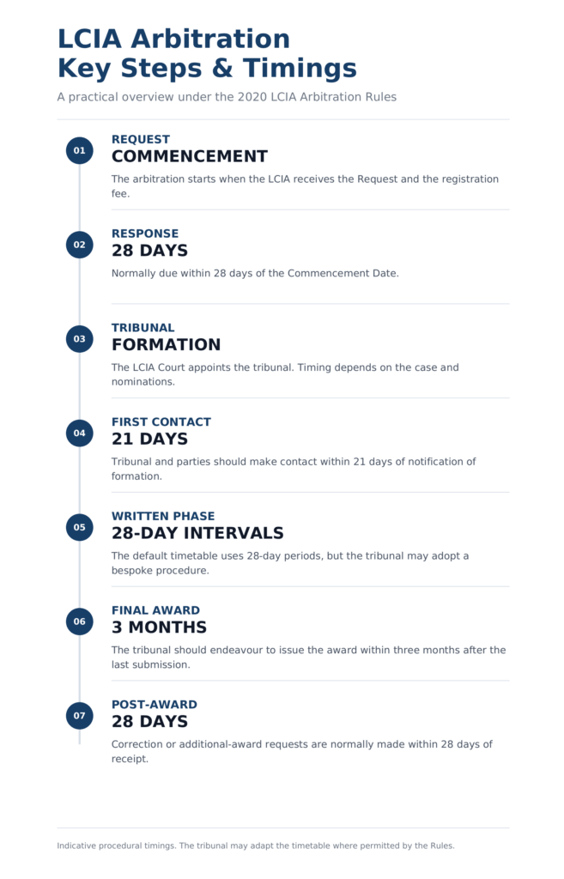
At a Glance: The Main Stages of an LCIA Arbitration
The timeline below offers an overview of the main procedural timings under the 2020 LCIA Rules. While some deadlines are set by the LCIA Rules, the overall timetable remains flexible and can be tailored to the dispute.
1. Why Parties Choose LCIA Arbitration
The LCIA is one of the longest-established international arbitral institutions. Its modern structure separates the LCIA company and board, the LCIA Court, and the Secretariat led by the Registrar:
- The Court performs the institutional functions assigned by the LCIA Rules, including appointments, challenges and costs determinations;
- The Secretariat handles day-to-day case administration; and
- The tribunal decides jurisdiction, procedure and the merits.[4]
Despite its name, the LCIA is not restricted to disputes connected with London or governed by English law. Parties may choose any arbitral seat and any substantive law, and hearings can be held anywhere or conducted virtually. London is only the default seat when the parties have not agreed otherwise, and the tribunal does not select a more appropriate seat after hearing the parties.[5]
Among the features that distinguish LCIA arbitration, three are particularly significant for users:
- First, arbitrator appointments are centrally supervised: the LCIA Court formally appoints every arbitrator and checks independence, impartiality and availability.
- Second, unlike some other arbitral institutions, such as the ICC, the LCIA generally calculates its administrative charges and arbitrators’ fees on a time-spent basis rather than by reference to the amount in dispute.
- Third, the LCIA Rules combine confidentiality with broad procedural discretion, including powers to use technology, sequence issues, limit evidence and make an early determination of claims or defences that meet the LCIA Rule’s high threshold.[6]
The LCIA’s caseload also reflects the breadth of commercial disputes it administers. Transport and commodities disputes represented the largest share of cases, at 29%, followed by banking and finance at 17%, energy and resources at 10%, construction and infrastructure at 8%, and technology at 6%. Although London remained by far the most common seat, accounting for 89% of LCIA arbitrations, the LCIA administered cases involving 21 different seats across 15 jurisdictions, and 35 substantive laws.[7]
2. Preparing to Commence LCIA Arbitration
2.1 Confirm That the Clause Actually Provides for LCIA Arbitration
Start with the arbitration agreement. The 2020 LCIA Arbitration Rules treat a written agreement referring disputes to arbitration under the LCIA, or under one of its former names, as an agreement to arbitrate under the LCIA Rules. But “arbitration in London” generally identifies a place, not necessarily LCIA administration.[8]
The LCIA Rules in force when the arbitration starts will generally apply, unless the parties agreed otherwise. Before filing, counsel should review the arbitration clause, any later amendments, assignments or novations, and any bespoke procedural terms to ensure they are consistent with the current LCIA Rules.[9]
2.2 Check Conditions Precedent and Limitation Periods
Many contracts require certain steps before arbitration can begin, such as negotiation, mediation, formal notice, an engineer’s decision or a cooling-off period. The claimant should check carefully whether those requirements have been met and how they interact with any limitation period. Filing at the last minute is risky, particularly because an LCIA arbitration does not commence until both the Request and the registration fee have been received.[10]
2.3 Choose the Seat with Legal Consequences in Mind
The seat is the legal home of the arbitration. The seat is legally distinct from the place where a hearing is held, although the two may be the same. It determines matters such as the procedural law, the courts with supervisory jurisdiction and the place where the award is legally treated as having been made. Under Article 16.4 of the LCIA Rules, the law of the seat generally applies to the arbitration agreement and the arbitration unless the parties have validly agreed otherwise. The LCIA Rules themselves are interpreted in accordance with English law.[11]
Where London is the seat, the Arbitration Act 1996 applies, as amended by the Arbitration Act 2025 (see English Arbitration Act 2025: Key Reforms). For arbitrations commenced on or after 1 August 2025, the amended Act includes new provisions on the law governing the arbitration agreement, summary disposal and the powers available in support of emergency arbitrators.[12]
2.4 Identify the Right Parties and Remedies
Before filing, the claimant should be clear about both who it is pursuing and what it wants to achieve. That starts with reviewing the relevant contracts, guarantees, assignments and any potential non-signatories. Each proposed respondent should have a clear connection to the claim and the arbitration agreement. Including unnecessary parties may lead to jurisdictional disputes, while leaving out a necessary party may make the case harder to restructure later.[13]
The claimant should also consider what relief it actually needs. Damages may be sufficient in the long term, but they may do little to address an immediate risk to assets, goods, confidential information or payment. In those circumstances, urgent or interim relief may also be necessary.
2.5 Preserve Evidence and Think Ahead to Enforcement
Early preparation should cover both evidence and enforcement. Preserve the documents and electronic records needed to prove the case, and speak with key witnesses before memories fade. In parallel, identify the respondent’s assets and the jurisdictions where enforcement may be required. The practical objective is not only to win, but to turn the award into an actual recovery.
3. Commencing the Arbitration: The Request for Arbitration
3.1 What the Request Must Contain
An LCIA arbitration starts when the claimant submits an electronic Request for Arbitration to the Registrar. Under Article 1.1, the Request must identify the parties, set out the arbitration agreement, include the relevant contractual documents, briefly describe the dispute and the claims being made, and state the estimated amount or value in dispute. It should also address any agreed or proposed procedural matters, include any required arbitrator nomination, and confirm both payment of the registration fee and delivery of the Request to the other parties.[14]
There is no prescribed form or page limit. The LCIA Guidance Note indicates that Requests are often around 10 to 15 pages, unless the claimant intends the Request to serve as its Statement of Case. How much detail to include is largely a strategic choice. A shorter Request may leave more room to develop the case later, while a more detailed filing may be appropriate where urgent relief is sought, the dispute is document-heavy, or limitation is a concern.[15]
3.2 The Commencement Date and the Registration Fee
The arbitration commences when the Registrar receives the electronic Request and documents, provided the LCIA has received the fee. If the fee arrives later, that later date is the Commencement Date. The current non-refundable registration fee is GBP 1,950, plus VAT where applicable.[16]
The Commencement Date starts the 28-day period for the Response and may also be important for limitation purposes. If time is tight, the claimant should check in advance that the registration fee has been paid, the Request can be submitted electronically without technical issues, the correct service addresses are being used, and proof of transmission can be retained.
3.3 Who Serves the Request?
The claimant, rather than the LCIA, is ordinarily responsible for serving the Request. It must be able to show that the Request was actually delivered or, if delivery is not possible, explain why and propose another effective method of notification. Following any contractual notice requirements and using agreed electronic channels with clear confirmation of delivery can help avoid later disputes over service and due process.[17]
3.4 Composite Requests for Multiple Arbitrations
Article 1.2 allows a claimant to commence multiple arbitrations through a single composite Request. The requirements of Article 1.1 must still be met for each arbitration, and the applicable registration fee must be paid for each case. A composite Request is therefore mainly an administrative convenience. It does not merge the arbitrations, which remain separate unless consolidation or concurrent conduct is later ordered.[18]
4. Responding to the Request
The Response is the respondent’s first formal opportunity to set out its position, and it is normally due within 28 days of the Commencement Date. The Response should confirm or deny the claim, summarise the dispute and defence, identify counterclaims and cross-claims, respond to procedural proposals, make any agreed nomination and confirm service on the other parties. There is no filing fee for a Response.[19]
The Response can be relatively brief because the respondent will have a later opportunity to present its full defence. The focus at this stage should be on the issues that cannot safely be left until later. These may include jurisdiction, limitation affecting counterclaims, the composition of the tribunal, the seat and language, and any need for interim protection. Evidence should also be secured promptly, and relevant insurers, funders or other stakeholders should be notified where necessary.[20]
The Response deadline matters most for arbitrator nominations. A respondent that misses the deadline may still defend the claim and bring counterclaims or cross-claims, but it can lose the right to nominate or propose an arbitrator. For that reason, any request for more time should be made before the deadline expires.[21]
Jurisdictional objections must be raised as soon as possible and, in any event, no later than the Statement of Defence or the corresponding defence to a counterclaim or cross-claim. A respondent can develop its jurisdictional arguments later, but it is generally prudent to reserve its position in the Response. Leaving the issue too late may invite a waiver argument or criticism that the objection was not raised promptly.[22]
5. Deposits and Funding: Advance Payments for Costs
After registration, the LCIA will call for advance payments under Article 24 to cover the expected costs of the arbitration. These include the LCIA’s administrative charges, the tribunal’s fees and expenses, and other Arbitration Costs. For a more detailed breakdown of the costs involved in an LCIA arbitration, including institutional charges, arbitrator fees, legal fees, expert costs and hearing expenses, see Aceris Law’s note on Total LCIA Arbitration Costs.
The LCIA does not necessarily collect the entire estimated cost at the beginning; the LCIA Guidance Note explains that advances are generally staged as the case progresses and as the tribunal’s anticipated work becomes clearer.[23]
If one party fails to pay its share, the LCIA may invite or direct another party to make a substitute payment so that the arbitration can continue. The paying party may then request an order or award for immediate reimbursement as a debt, together with interest. If sufficient funds are not held, the tribunal should generally not proceed, and a hearing may be postponed.[24]
The overall budget should also account for costs beyond the LCIA and tribunal fees. Legal fees, document review, translations, witnesses, experts, hearing services, travel and enforcement can make up the majority of the total expense. It is useful to budget by procedural stage and revisit the figures after case management, document production and expert work have been defined.
6. Constituting the Tribunal
6.1 Nomination Is Not Appointment
The LCIA Court alone formally appoints arbitrators. An agreement stating that a party “appoints” an arbitrator is treated as an agreement to nominate a candidate. The Court may refuse a nominee who does not satisfy the requirements of independence, impartiality and availability, or who is otherwise unsuitable. The LCIA’s appointment process therefore provides an institutional check on the suitability of every arbitrator appointed.[25]
6.2 Sole Arbitrator or Three-Member Tribunal
A sole arbitrator will usually be appointed unless the parties have agreed on a three-member tribunal or the LCIA Court considers that three arbitrators are more appropriate in the circumstances. In making that decision, the Court may consider factors such as the nature and value of the dispute, the transaction involved, the parties’ locations and languages, and the number of parties. A three-member tribunal can bring a broader range of experience, but it will generally be more expensive and may take longer to coordinate.[26]
Arbitrator selection should focus on the needs of the case. Experience with the governing law and sector, language ability, damages expertise, procedural judgement and availability are often more important than prestige. Very narrow requirements can reduce the available pool and make appointments harder to complete.
6.3 How the LCIA Selects Arbitrators
The Secretariat reviews the case and identifies the experience and other qualities likely to be relevant when selecting an arbitrator. It may draw candidates from the LCIA’s database or other sources. Before appointment, each candidate must provide information about their qualifications, agree their fee rate, disclose any circumstances that could raise doubts about their independence or impartiality, and confirm that they have sufficient time to conduct the arbitration efficiently.[27]
Nationality is also relevant. Where the parties have different nationalities, a sole arbitrator or presiding arbitrator will generally not have the same nationality as any party unless the other parties consent in writing. For companies, nationality may extend beyond the place of incorporation to the seat of effective management and the nationality of controlling shareholders or interests, which can become important in disputes involving corporate groups.[28]
6.4 Challenges and Continuing Disclosure
Arbitrators remain under a continuing duty to disclose any circumstances that may raise doubts about their independence or impartiality. A party wishing to challenge an arbitrator must normally do so within 14 days of the tribunal’s formation or within 14 days of becoming aware of the relevant circumstances. If the challenge is contested, the LCIA Court decides it in writing and gives reasons. A challenge should be based on the grounds set out in the Rules, rather than simply on disagreement with the tribunal’s procedural decisions.[29]
Challenges are relatively uncommon and rarely succeed. In 2024, the LCIA received ten challenges under the LCIA Rules, none of which was upheld. The LCIA also reported that only one challenge had been upheld in the previous six years. A challenge should be supported by specific evidence concerning independence, impartiality, fitness or serious misconduct, rather than dissatisfaction with the way the arbitration is being conducted.[30]
7. Urgent Relief Before the Tribunal Is Constituted
7.1 Expedited Formation Under Article 9A of the LCIA Rules
Where there is exceptional urgency, a party may ask the LCIA Court to form the permanent tribunal more quickly under Article 9A of the LCIA Rules. The application must explain why the case is exceptionally urgent and must be copied immediately to the other parties. If the application is granted, the LCIA Court may shorten the time limits needed to constitute the tribunal. One advantage is that the tribunal appointed on an expedited basis will remain in place for the rest of the case, avoiding the need to transfer responsibility from a temporary decision-maker.[31]
7.2 Emergency Arbitrator Under Article 9B of the LCIA Rules
Where urgent relief cannot wait for the permanent tribunal to be formed, a party may apply under Article 9B for the appointment of an Emergency Arbitrator.[32] The application must explain the emergency, identify the specific relief sought and the reasons for it, include the relevant supporting documents, and be sent immediately to all other parties. The applicant must also pay the Special Fee. If the application is granted, the LCIA Court will appoint the Emergency Arbitrator within three days of receiving the application, or as soon as possible thereafter. The Emergency Arbitrator must then decide the application as soon as possible and, in any event, within 14 days of appointment.[33]
Under the Schedule of Costs effective 1 December 2023, the Special Fee is GBP 35,000, comprising a GBP 10,000 non-refundable application fee and a GBP 25,000 Emergency Arbitrator fee. The latter may be increased if the circumstances of the case justify it. If the LCIA Court refuses the application, the GBP 25,000 Emergency Arbitrator fee is treated as an Advance Payment for Costs in the arbitration.[34] Article 9B does not generally apply to arbitration agreements concluded before 1 October 2014 unless the parties have agreed to opt in, and the parties may also agree in writing to opt out.[35]
The procedure is used relatively sparingly. In 2024, the LCIA received 15 applications for expedited formation and four applications for the appointment of an Emergency Arbitrator. Only one application in each category was granted. As a practical matter, an applicant should identify the immediate risk, explain clearly why the relief cannot wait for the permanent tribunal, and ask for an order that is precise and capable of being implemented quickly.[36]
7.3 When Court Assistance May Be Needed
The availability of expedited formation or an Emergency Arbitrator does not prevent a party from seeking urgent relief from a national court. Article 9.13 of the LCIA Rules expressly preserves that option before the tribunal is formed, while Article 25.3 allows court applications before formation and, in exceptional circumstances, after the tribunal is in place. Which route is preferable will depend on the relief required, where the relevant assets or evidence are located, the need for confidentiality, and how readily any order can be enforced. A party seeking court relief should also make sure that it complies with the notification requirements under the LCIA Rules.[37]
8. Setting the Course of the Arbitration
Once the tribunal is formed, the centre of gravity shifts from the LCIA Secretariat to the tribunal. Article 14.1 of the LCIA Rules requires the tribunal to act fairly and impartially, give each party a reasonable opportunity to present its case, and adopt procedures suited to the dispute while avoiding unnecessary delay and expense. Article 14.2 gives the tribunal the widest discretion to discharge those duties, subject to mandatory law, and requires the parties to cooperate in good faith.[38]
The tribunal and parties must make contact as soon as practicable and no later than 21 days after the Registrar’s notification of formation. In practice, the tribunal usually circulates an agenda and holds an initial procedural conference. The parties can help shape the procedure through joint proposals, while the tribunal retains overall responsibility for case management.[39]
8.1 What Should Be Decided Early
The first procedural conference should address the main issues that will shape the case, including jurisdiction, the seat and language, the sequence of submissions, document production, witness and expert evidence, any preliminary or interim applications, the hearing format, confidentiality, data security and costs. It is also useful to agree realistic dates for the final submissions and, where possible, the expected timing of the award. Procedural Order No. 1 should give the case a clear structure without making the timetable unnecessarily rigid.
The LCIA Guidance Note encourages tribunals to set a realistic timetable, keep it under review and plan ahead for deliberations. The procedure should reflect the needs of the particular dispute. A construction case involving delay experts, for example, will require a very different timetable from a straightforward commodities debt claim or a shareholder dispute involving allegations of fraud.[40]
8.2 Powers to Streamline the Case
Article 14.6 of the LCIA Rules allows the tribunal to limit submissions and testimony, use technology, sequence issues, dispense with a hearing where permitted, make an early determination and shorten periods. The LCIA has no separate one-size-fits-all expedited track; the process is tailored to the case.[41]
8.3 Tribunal Secretaries, Representatives and Cybersecurity
A tribunal secretary may be appointed under Article 14A, but only with the parties’ approval of the proposed secretary, their role and their remuneration. The tribunal cannot delegate any decision-making function to the secretary. Parties should therefore make sure the secretary’s tasks are clearly defined from the outset and raise any concern promptly if the role appears to go beyond administrative support.[42]
Changes in legal representation should also be disclosed promptly. Once the tribunal has been formed, it may refuse a proposed change where this is necessary to protect the composition of the tribunal or the finality of the award. The Annex to the LCIA Rules also sets standards of conduct for party representatives, and breaches may result in a reprimand, caution, other measures or consequences in costs.[43]
Data protection and information security should be addressed early as well. Article 30.5 requires the tribunal, in consultation with the parties and, where appropriate, the LCIA, to consider whether specific information-security and data-protection measures should be adopted. In practice, this may include agreeing on a secure document platform, access controls, encryption, procedures for sensitive material, breach notification and rules on recording remote hearings.[44]
9. The Written Phase: Pleadings, Documents and the Default Timetable
Article 15 of the LCIA Rules sets out the default sequence for written submissions, unless the parties agree otherwise or the tribunal directs a different procedure:
- Under Article 15.2 of the LCIA Rules, the claimant normally has 28 days from notification of the tribunal’s formation to submit its Statement of Case or confirm that its Request will stand as the Statement of Case.
- The respondent then has 28 days to submit its Statement of Defence and any Counterclaim.
- The claimant has a further 28 days to file its Reply and, where applicable, Defence to Counterclaim, followed by a final 28-day period for the respondent’s Reply to the Defence to Counterclaim.
- No further written submissions may be filed unless the tribunal permits them.[45]
This default sequence is only a starting point. Article 15.7 of the LCIA Rules gives the tribunal broad flexibility to adopt a different structure where the case requires it. In larger or more complex disputes, the parties may file memorials combining legal submissions with documents, witness statements and expert reports. In other cases, the tribunal may separate written submissions from document production and witness or expert evidence. The most suitable approach will depend on the nature of the dispute and whether the key issues turn mainly on documents, witness credibility, expert analysis, legal interpretation or jurisdiction.[46]
A party’s failure to participate does not result in an automatic win for the other side. Article 15.8 of the LCIA Rules allows the tribunal to continue the arbitration despite a party’s failure to present its case, but the participating party must still establish jurisdiction, liability and the relief claimed. Proper records of service and of the absent party’s opportunity to participate are therefore important, particularly with future enforcement in mind.[47]
Article 15.10 of the LCIA Rules also encourages the tribunal to move promptly toward the final award. The tribunal must seek to issue the award as soon as reasonably possible and endeavour to do so within three months of the parties’ last submission, in accordance with a timetable notified to the parties and the Registrar. That target should be considered when setting the procedural calendar. Hearing dates, post-hearing submissions and costs submissions should leave sufficient time for deliberations and preparation of the award.[48]
10. Jurisdiction and Early Resolution of Key Issues
10.1 The Tribunal Can Decide Its Own Jurisdiction
Article 23 of the LCIA Rules gives the tribunal the power to decide its own jurisdiction, including questions concerning the existence, validity, effectiveness and scope of the arbitration agreement. It also recognises the principle of separability, meaning that the arbitration clause is treated as legally independent from the contract containing it. As a result, a finding that the underlying contract is invalid does not, by itself, invalidate the arbitration agreement.[49]
A jurisdictional objection does not necessarily have to be decided before the merits. Under Article 23.4 of the LCIA Rules, the tribunal may decide it in a separate award on jurisdiction or deal with it later as part of the merits. The practical question is whether deciding jurisdiction separately will actually save time and cost. A separate phase may make sense where a narrow jurisdictional issue could dispose of the entire case and can be decided on a limited factual record. It may be less useful where the jurisdictional and merits issues substantially overlap or where the same evidence would have to be considered twice.[50]
10.2 Early Determination Under Article 22.1(viii) of the LCIA Rules
Article 22.1(viii) of the LCIA Rules gives the tribunal a separate tool for disposing of claims or defences at an early stage. The tribunal may determine that a claim, defence, counterclaim, cross-claim or related defence is manifestly outside its jurisdiction, inadmissible or manifestly without merit.
The threshold is deliberately high. An application is most likely to be useful where it identifies a narrow issue that could dispose of all or a significant part of the case without requiring extensive evidence or submissions. The applicant should explain precisely what issue can be decided, what material the tribunal needs and what procedure would allow both sides a fair opportunity to be heard. If the application simply repeats arguments that will require a full examination of the merits, it risks creating an additional procedural dispute rather than saving time or cost.[51]
The mechanism remains used relatively sparingly. In 2024, the LCIA recorded 16 applications for early determination. One was granted, eight were rejected, five were withdrawn, one was superseded, and one remained pending.[52] For arbitrations falling within the scope of the English Arbitration Act 1996, as amended, section 39A also provides a statutory power to make an award on a summary basis. The statutory provision and Article 22.1(viii) of the LCIA Rules are separate mechanisms, however, and their requirements should be considered independently.
10.3 Deciding Issues in Stages
Formal bifurcation is not the only way to deal with an issue early. Article 22.1(vii) of the LCIA Rules allows the tribunal to decide when particular issues will be determined, in what order and under what procedure. This gives the tribunal considerable flexibility to structure the case around the issues that matter most.
For example, the tribunal might decide a discrete question of contract interpretation before turning to the remaining claims, determine liability before quantum, resolve a limitation issue on agreed facts or deal with competing expert methodologies in stages. The important question is what will actually be gained by doing so. Parties proposing a separate phase should explain the likely saving in time and cost, while also considering what happens if the preliminary issue does not resolve or materially narrow the dispute.
11. Documentary Evidence and Document Production
The LCIA Rules do not prescribe a fixed procedure for document production. Instead, Article 22.1(iii) to (vi) of the LCIA Rules gives the tribunal broad discretion over the evidentiary process. The tribunal may make its own enquiries, order the inspection of documents or property, require a party to produce documents within its possession, custody or power, and decide questions of admissibility, relevance and weight. Depending on the case, this may mean no separate document production at all, or a focused production exercise directed at particular issues.[53]
Where document production is appropriate, parties often use a Redfern Schedule to set out each request, its relevance, any objections and the tribunal’s decision. The LCIA Rules do not require this format, however, and a simpler approach may be more proportionate in some cases. The tribunal may use issue-based requests, another form of schedule or dispense with a separate production phase altogether.[54] For a broader explanation of how document production commonly works in international arbitration, see Aceris Law’s note on Document Production in International Arbitration.
Document production should remain focused. Where the IBA Rules on Evidence are used as guidance, requests should identify specific documents or narrow and specific categories of documents, explain their relevance and materiality, and state why they are believed to be in another party’s possession, custody or control. Objections may be based on matters such as lack of relevance or materiality, privilege, unreasonable burden, confidentiality or proportionality. The tribunal may also put appropriate confidentiality protections in place where sensitive material must be produced.[55] The IBA Rules on Evidence expressly address each of these points in Articles 3.3, 3.5, 9.2 and 9.5.
Preservation is a separate issue. Article 25.1(ii) of the LCIA Rules allows the tribunal to order the preservation or storage of documents and other property relating to the dispute. A party seeking such an order should identify the material at risk and explain why preservation is necessary.[56]
12. Fact Witnesses and Experts
12.1 Fact Witnesses
Article 20 of the LCIA Rules governs party witnesses, including fact witnesses. Their evidence may be given in writing, and the tribunal controls the timing, form and scope of that testimony. If a witness is ordered to attend a hearing but fails to do so without good reason, the tribunal may give less weight to the written statement or exclude it altogether.[57]
Witness statements should reflect the witness’s own recollection and make clear what comes from memory, documents or information provided by others. They should not read like legal submissions.
At the hearing, the tribunal controls the questioning of witnesses. Cross-examination is usually most effective when focused on facts that genuinely matter to the outcome. Where witnesses give evidence in more than one language, translation and interpretation arrangements should be addressed early.[58]
12.2 Party-Appointed and Tribunal-Appointed Experts
Article 21 of the LCIA Rules deals with experts appointed by the tribunal. Party-appointed experts are usually governed by the tribunal’s procedural directions. Expert evidence is most useful when the issues are clearly defined and, where possible, the experts work from agreed data, assumptions, dates and terminology.
A tribunal-appointed expert (which is rare) must remain independent and report to both the tribunal and the parties. The parties should have a fair opportunity to review the expert’s mandate, materials and methodology, raise any conflict concerns, comment on the report and question the expert if required.[59]
Party-appointed experts often are asked to meet before the hearing to identify the points on which they agree and disagree. The tribunal may also hear expert evidence concurrently, which can help clarify competing approaches and focus the discussion on the issues that remain in dispute.[60]
13. The Hearing: Format, Procedure and Privacy
Any party has a right to a hearing before a ruling on jurisdiction or an award on the merits, unless the parties agreed in writing to a documents-only arbitration. The hearing may be divided into separate sessions where appropriate. The tribunal decides the date, duration, form, content, procedure, time limits and geographical place after consulting the parties, and all hearings are private unless the parties agree otherwise.[61]
Hearings may take place in person, remotely or in a hybrid format. The tribunal should choose the format that best balances fairness, efficiency and the needs of the case. Hybrid hearings require particular care to ensure that all participants can follow the evidence, access documents and communicate effectively.[62]
Before the hearing, the tribunal and parties should agree the practical arrangements, including witness order, time limits, examination procedure, hearing bundles, transcripts, interpretation, confidentiality and any post-hearing submissions. Time zones, accessibility and technical contingencies should also be considered.[63]
The hearing venue does not determine the legal seat of the arbitration. A London-seated arbitration may hold hearings in Paris, Dubai, Singapore or anywhere else, including entirely online, without changing the seat. The award will still be treated as having been made in London.[64]
Hearing costs, including venue, platform, transcription and interpretation, are not paid from the general Advance Payment for Costs unless arrangements are made. Parties should obtain quotes early, identify cancellation terms and decide whether the LCIA should include agreed hearing expenses in future advances.[65]
14. Multi-Party and Multi-Contract Disputes
14.1 Joinder
Under Article 22.1(x) of the LCIA Rules, a third party can only be joined where that party and the applicant have expressly agreed in writing after the Commencement Date, or where the required consent is already contained in the arbitration agreement. Joinder is therefore limited and cannot be used simply to bring any related company or other commercially connected entity into the arbitration. If the claimant needs relief against a particular entity, it should consider from the outset whether there is a proper jurisdictional basis to name that entity as a respondent.[66]
14.2 Consolidation and Concurrent Conduct
Article 22A provides several routes. With LCIA Court approval, a tribunal may consolidate cases where all parties agree, or in defined circumstances where arbitrations arise under the same or compatible arbitration agreements and involve the same disputing parties or the same transaction or series of related transactions. The LCIA Court may consolidate related cases at an early stage, before the tribunals are constituted. Alternatively, the same tribunal may hear the arbitrations concurrently, allowing procedural coordination without formally combining the proceedings.[67]
Consolidation and concurrent conduct serve different purposes. Consolidation brings the proceedings together into a single arbitration, while concurrent conduct allows separate arbitrations to be coordinated procedurally. In either case, parties should consider tribunal composition, the treatment of evidence across proceedings, confidentiality, due process and whether separate or combined awards will be required.
The 2024 statistics show that consolidation is used relatively frequently. The LCIA recorded 40 applications, 39 of which were granted, while one was superseded by settlement. In addition, 22 of 29 composite Requests resulted in consolidation. Concurrent conduct was less common, with three requests recorded, two granted and one later replaced by consolidation. Joinder was used even less often: eight applications were made, with one granted, four rejected and three either superseded or pending.[68]
15. Interim Measures and Security for Costs
After the tribunal is formed, Article 25 of the LCIA Rules gives it broad powers to grant interim and conservatory relief. The tribunal may order security for all or part of the amount in dispute, take steps to preserve or deal with documents or property relating to the dispute, and grant provisional relief that could ultimately be awarded, including the payment of money or the disposition of property. Before making such an order, the tribunal must give the parties a reasonable opportunity to respond.[69]
Article 25.2 of the LCIA Rules separately allows the tribunal to order security for costs on such terms as it considers appropriate. A party seeking security should explain clearly why it is needed and identify the amount and form of security sought. In 2024, security for costs was the most commonly requested interim measure. Overall, parties made 65 applications for interim and conservatory measures across 48 LCIA arbitrations. Fourteen were granted, ten were partially granted, 28 were rejected, ten were withdrawn or superseded, and three remained pending.[70]
16. Costs and Cost Control
16.1 How LCIA Costs Are Calculated
LCIA arbitration follows a largely time-based cost model. Under the Schedule of Costs effective 1 December 2023, the LCIA charges for Secretariat time at published hourly rates, while arbitrator fees are generally set between GBP 250 and GBP 650 per hour, depending on factors such as the complexity of the case and the experience required. Tribunal secretary rates of GBP 100 to GBP 250 per hour are generally considered reasonable. At the end of the case, the LCIA Court determines the Arbitration Costs after reviewing the work performed and the relevant fee notes.[71]
This hourly approach can be particularly attractive in high-value disputes where the amount claimed does not necessarily reflect the complexity of the case (by contrast, under the ICC’s value-based fee structure, even a relatively straightforward dispute can generate substantial institutional and arbitrator fees if the amount in dispute is very large). The way the arbitration is managed will also affect cost. Keeping document production, expert evidence and hearings focused can avoid unnecessary expense.
16.2 How Costs Are Allocated Between the Parties
The tribunal decides how both the Arbitration Costs and the parties’ recoverable Legal Costs should be allocated. Article 28.4 of the LCIA Rules starts from the general principle that costs should reflect the parties’ relative success and failure, although the tribunal may depart from that approach where the circumstances justify it. The tribunal may also consider how the parties and their representatives conducted the arbitration, including whether they cooperated in saving time and cost or caused unnecessary delay and expense. Any decision on costs must give reasons, except in a Consent Award.[72]
Costs do not necessarily follow the overall result. A party may succeed on the main claim but recover only part of its costs if it loses important issues, advances an exaggerated claim or conducts the proceedings inefficiently. Parties should therefore keep clear records of their costs by workstream and be prepared to explain why the amounts claimed are reasonable and proportionate.[73]
16.3 What the Published Cost and Duration Data Show
The LCIA’s 2024 Costs and Duration Analysis reviewed 616 cases that reached a final award between 1 January 2017 and 12 May 2024. It reported a median arbitration cost of USD 117,653 and a median overall duration of 20 months. Tribunals took a median of around four months from the final merits submission to the award, while cases involving claims below USD 1 million had a median overall duration of about 12 months.[74]
These figures are useful benchmarks, but they should not be treated as estimates for a particular case. The analysis excludes arbitrations that settled before a final award and does not include costs incurred by the parties themselves, such as legal fees, expert fees and the costs of preparing and presenting evidence. Its comparisons with other institutions also combine actual LCIA costs with estimates generated from those institutions’ published cost tools, so differences in methodology and case profiles should be kept in mind.[75]
17. The Award, Corrections and Settlement
17.1 Form and Delivery of the Award
Under Article 26 of the LCIA Rules, the tribunal may issue separate awards on different issues, including jurisdiction, liability, quantum, interim payments and costs. Unless the parties agree otherwise, an award must be in writing, give reasons, state the date and seat of the arbitration, and be signed by the arbitrators who agree with it. Awards may also be signed electronically or in counterparts unless the parties, the tribunal or the LCIA Court directs otherwise. The tribunal may award simple or compound interest at a rate and for a period it considers appropriate.[76]
Once the award is ready, the sole or presiding arbitrator sends it to the LCIA Court. The Registrar then transmits the authenticated award to the parties once the Arbitration Costs have been paid in full. Unlike the ICC process, the LCIA Rules do not provide for formal institutional scrutiny of a draft award before it is issued. Responsibility for producing a complete and enforceable award therefore rests primarily with the tribunal.[77]
17.2 Correction and Additional Awards
Article 27 of the LCIA Rules provides a limited mechanism for correcting an award. Within 28 days of receiving it, a party may ask the tribunal to correct a computational, clerical or typographical error, an ambiguity or a similar mistake. If the request is justified, the tribunal records the correction in an addendum, normally within 28 days of receiving the request.[78]
A party may also request an additional award where a claim, counterclaim or cross-claim was presented in the arbitration but not decided. The request must be made within 28 days of receiving the final award and, if justified, the tribunal must issue the additional award within 56 days.
Article 27 is not an opportunity to reargue the merits. A request should identify the specific error, ambiguity or omitted claim and explain clearly why it falls within the limited scope of the Rule. Where helpful, the requesting party can also suggest the wording of the correction.
17.3 Settlement and Consent Awards
The parties may settle their dispute at any stage of the arbitration. If they jointly request it, the tribunal may record the settlement in a Consent Award under Article 26.9 of the LCIA Rules. A Consent Award may be useful where the parties want the settlement terms reflected in an arbitral award for enforcement purposes.[79]
Before choosing that route, the parties should consider how the settlement deals with confidentiality, tax, regulatory approvals, payment mechanics, releases and any other obligations that will need to be performed. The terms should also be clear enough to be incorporated into an award. If the parties do not request a Consent Award, the LCIA Court will conclude the arbitration once it has received confirmation of the settlement and any outstanding Arbitration Costs have been paid.
18. Confidentiality, Finality and Enforcement
18.1 Confidentiality Is Broad but Not Absolute
Article 30 of the LCIA Rules requires the parties, tribunal, tribunal secretary and tribunal-appointed experts to keep awards and arbitration materials confidential. There are limited exceptions, including where disclosure is required by law, necessary to protect or pursue a legal right, or needed for enforcement or challenge proceedings. Parties must also seek similar confidentiality undertakings from their representatives, witnesses, experts and service providers. The LCIA will not publish an award without the prior written consent of all parties and the tribunal.[80]
Any external disclosure requirements should be identified early. Regulators, auditors, insurers, lenders, public bodies or funders may need access to certain materials. Where appropriate, the parties should agree a protocol covering permitted recipients, security measures, redactions and the treatment of documents that may later need to be filed in court.
18.2 Finality, Set-Aside and Enforcement
Under Article 26.8 of the LCIA Rules, awards are final and binding, and the parties undertake to comply with them without delay, subject to the limited correction process under Article 27. The law of the seat may nevertheless allow an award to be challenged or set aside on limited grounds. Recognition and enforcement abroad will typically be governed by the New York Convention, which permits refusal only on specified grounds, including invalidity of the arbitration agreement, lack of proper notice or opportunity to present a case, excess of jurisdiction, procedural irregularity, non-arbitrability and public policy.[81]
Parties should be thinking about enforcement before the arbitration ends. The successful party should know where assets are located and whether any ownership, security or sovereign issues may affect recovery. The losing party should consider whether to comply, provide security, settle or pursue any available challenge.
18.3 Raise Procedural Objections Promptly
Article 32.1 of the LCIA Rules provides that a party that knowingly continues with the arbitration without promptly objecting to non-compliance with the arbitration agreement may lose the right to raise that objection later. This can apply to matters such as tribunal formation, document production, time limits, joinder, the seat, language and hearings. A party should therefore raise any objection clearly and promptly, and seek appropriate relief, rather than holding the point back for a later challenge.[82]
The record should also support the enforceability of the eventual award. Service should be documented, each party should be given a fair opportunity to comment, objections should be raised in time, and important procedural decisions should be properly recorded. Article 32.2 of the LCIA Rules also requires the parties and tribunal to act in good faith and make reasonable efforts to support the recognition and enforceability of the award at the seat.[83]
Conclusion
LCIA arbitration is designed to be flexible, but that flexibility works best when the case is well prepared from the start. The Request sets the arbitration in motion, the Response gives the respondent an early opportunity to shape the case, the LCIA Court oversees appointments and costs, and the tribunal then adapts the procedure to the particular dispute.
In practice, many of the most important decisions are made before the first procedural conference. Careful review of the arbitration clause, the parties, the relief sought, the enforcement strategy and the choice of arbitrator can save significant time and cost later. With sensible case management and a proportionate approach to evidence and hearings, the 2020 LCIA Rules provide a practical and effective framework for resolving international disputes from commencement through to the final award.
[1] LCIA Arbitration Rules 2020, Arts. 3, 5, 23 and 29 (effective 1 October 2020) (“LCIA Rules”); L. Richman, Chapter 1: Introduction and the Institution, in M. Scherer et al., Arbitrating under the 2020 LCIA Rules: A User’s Guide (2021), pp. 1-12, ¶¶ 1-18.
[2] LCIA, 2024 Annual Casework Report (June 2025), pp. 5-7.
[3] LCIA Rules, Preamble; LCIA, Schedule of Arbitration Costs (effective 1 December 2023).
[4] Richman, Chapter 1, pp. 1-12, ¶¶ 8-34; LCIA Rules, Arts. 3 and 29.
[5] LCIA Rules, Art. 16.1-16.3; L. Richman, Chapter 13: Seat and Place of Arbitration, in M. Scherer et al., Arbitrating under the 2020 LCIA Rules: A User’s Guide (2021), pp. 219-228, ¶¶ 1-13.
[6] R. Gerbay, Chapter 3: Key Reasons for Choosing LCIA Arbitration, in M. Scherer et al., Arbitrating under the 2020 LCIA Rules: A User’s Guide (2021), pp. 17-26, ¶¶ 5-35; R. Gerbay, Chapter 2: Key Changes Introduced by the 2020 Rules, in M. Scherer et al., Arbitrating under the 2020 LCIA Rules: A User’s Guide (2021), pp. 13-16, ¶¶ 3-10.
[7] LCIA, 2024 Annual Casework Report, pp. 5, 9 and 16.
[8] LCIA Rules, Preamble; LCIA, Guidance Note for Parties and Arbitrators, ¶¶ 8-13 (“LCIA Guidance Note”).
[9] LCIA Rules, Preamble; M. Scherer, Chapter 7: Tribunal’s Jurisdiction, in M. Scherer et al., Arbitrating under the 2020 LCIA Rules: A User’s Guide (2021), pp. 81-98, ¶¶ 2-12.
[10] LCIA Rules, Arts. 1.1(vi), 1.4 and 2.1; L. Richman, Chapter 5: Request for Arbitration, in M. Scherer et al., Arbitrating under the 2020 LCIA Rules: A User’s Guide (2021), pp. 53-68, ¶¶ 5-9 and 35-40.
[11] LCIA Rules, Art. 16.1-16.5; Richman, Chapter 13, ¶¶ 1-18.
[12] Arbitration Act 1996, ss. 6A, 39A, 41A, 44, as amended by Arbitration Act 2025, ss. 1, 7, 8; Arbitration Act 2025 (Commencement) Regulations 2025, SI 2025/905 (C. 41), reg. 2.
[13] Richman, Chapter 5, ¶¶ 13-16; LCIA Rules, Art. 22.1(x).
[14] LCIA Rules, Art. 1.1-1.3; Richman, Chapter 5, ¶¶ 5-12.
[15] LCIA Guidance Note, ¶¶ 19-23.
[16] LCIA Rules, Art. 1.4; LCIA, Schedule of Arbitration Costs, § 1(i).
[17] LCIA Rules, Arts. 1.1(vii) and 4.1-4.6; Richman, Chapter 5, ¶¶ 8-9 and 15-16.
[18] LCIA Rules, Art. 1.2; LCIA Guidance Note, ¶¶ 51-54.
[19] LCIA Rules, Art. 2.1-2.3; LCIA Guidance Note, ¶¶ 65-73.
[20] L. Richman, Chapter 6: Response, in M. Scherer et al., Arbitrating under the 2020 LCIA Rules: A User’s Guide (2021), pp. 69-80, ¶¶ 1-11.
[21] LCIA Rules, Art. 2.4; Richman, Chapter 6, ¶¶ 2-5 and 24-29.
[22] LCIA Rules, Art. 23.3; Scherer, Chapter 7, ¶¶ 39-47.
[23] LCIA Rules, Art. 24.1-24.5; LCIA Guidance Note, ¶¶ 328-343.
[24] LCIA Rules, Art. 24.5-24.8; LCIA Guidance Note, ¶¶ 338-343.
[25] LCIA Rules, Arts. 5.3-5.9 and 7.1; M. Scherer, Chapter 9: Formation of the Arbitral Tribunal, in M. Scherer et al., Arbitrating under the 2020 LCIA Rules: A User’s Guide (2021), pp. 109-144, ¶¶ 1-31.
[26] LCIA Rules, Arts. 5.8-5.9; Scherer, Chapter 9, ¶¶ 12-21; LCIA Guidance Note, ¶¶ 95-101.
[27] LCIA Guidance Note, ¶¶ 97-109; Scherer, Chapter 9, ¶¶ 22-35.
[28] LCIA Rules, Art. 6.1-6.3; Scherer, Chapter 9, ¶¶ 63-75.
[29] LCIA Rules, Arts. 5.5 and 10.1-10.7; Scherer, Chapter 9, ¶¶ 96-119.
[30] LCIA, 2024 Annual Casework Report, p. 25.
[31] LCIA Rules, Art. 9A; LCIA Guidance Note, ¶¶ 138-153.
[32] For a broader discussion of the practical considerations involved in seeking urgent relief before the tribunal is constituted, see Aceris Law’s note on Emergency Arbitration: Balancing Urgency and Fairness.
[33] LCIA Rules, Arts. 9.4-9.9; LCIA Guidance Note, ¶¶ 154-181.
[34] For a comparison of the costs of emergency proceedings before the LCIA and other leading arbitral institutions, see Aceris Law’s note on Emergency Arbitration Costs.
[35] LCIA, Schedule of Arbitration Costs, § 5; LCIA Rules, Art. 9.16.
[36] LCIA, 2024 Annual Casework Report, p. 24.
[37] LCIA Rules, Arts. 9.13 and 25.3; Arbitration Act 1996, s. 44, as amended by Arbitration Act 2025, s. 8.
[38] LCIA Rules, Art. 14.1-14.2; L. Richman, Chapter 15: Conduct of Proceedings and Default Timetable, in M. Scherer et al., Arbitrating under the 2020 LCIA Rules: A User’s Guide (2021), pp. 237-256, ¶¶ 1-14.
[39] LCIA Rules, Art. 14.3-14.5; LCIA Guidance Note, ¶¶ 229-235.
[40] LCIA Guidance Note, ¶¶ 229-235; Richman, Chapter 15, ¶¶ 4-14.
[41] LCIA Rules, Art. 14.6; LCIA Guidance Note, ¶¶ 236-239; Gerbay, Chapter 2, ¶¶ 7-8.
[42] LCIA Rules, Art. 14A; Gerbay, Chapter 2, ¶ 10; LCIA Guidance Note, ¶¶ 182-211.
[43] LCIA Rules, Art. 18 and Annex; LCIA Guidance Note, ¶¶ 74-88.
[44] LCIA Rules, Art. 30A; LCIA Guidance Note, ¶¶ 378-389.
[45] LCIA Rules, Art. 15.1-15.6; Richman, Chapter 15, ¶¶ 15-30.
[46] LCIA Rules, Art. 15.7; Richman, Chapter 15, ¶¶ 31-39.
[47] LCIA Rules, Art. 15.8.
[48] LCIA Rules, Art. 15.10; Richman, Chapter 15, ¶¶ 49-55.
[49] LCIA Rules, Art. 23.1-23.2; Scherer, Chapter 7, ¶¶ 15-38.
[50] LCIA Rules, Art. 23.4; Scherer, Chapter 7, ¶¶ 48-55.
[51] LCIA Rules, Arts. 14.6(vi) and 22.1(viii); L. Richman, Chapter 17: Special Powers of the Tribunal, in M. Scherer et al., Arbitrating under the 2020 LCIA Rules: A User’s Guide (2021), pp. 277-292, ¶¶ 34-37.
[52] LCIA, 2024 Annual Casework Report, p. 26; Arbitration Act 1996, s. 39A.
[53] LCIA Rules, Art. 22.1(iii)-(vi); Richman, Chapter 17, ¶¶ 19-33.
[54] D. Prokić, Practical Insights on Documentary Evidence and Hearing Bundles – London Court of International Arbitration (LCIA), Practical Insights on Arbitral Procedure (last reviewed December 2024), pp. 1-3; LCIA Guidance Note, ¶¶ 240-247.
[55] LCIA Rules, Art. 22.1(iii) to (vi); International Bar Association, IBA Rules on the Taking of Evidence in International Arbitration (adopted 17 December 2020), Arts. 3.3, 3.5, 9.2, 9.5 (“IBA Rules on Evidence”).
[56] LCIA Rules, Art. 25.1(ii).
[57] LCIA Rules, Art. 20.1-20.5; L. Richman, Chapter 16: Hearings, Witnesses and Experts, in M. Scherer et al., Arbitrating under the 2020 LCIA Rules: A User’s Guide (2021), pp. 257-276, ¶¶ 20-37.
[58] LCIA Rules, Art. 20.6-20.9; Richman, Chapter 16, ¶¶ 38-48.
[59] LCIA Rules, Art. 21.1-21.5; Richman, Chapter 16, ¶¶ 49-59.
[60] LCIA Rules, Arts. 20.1, 20.4, 20.9; IBA Rules on Evidence, Arts. 5.4, 8.4(f).
[61] LCIA Rules, Art. 19.1-19.4; Richman, Chapter 16, ¶¶ 1-19.
[62] LCIA Rules, Arts. 14.6(iii), 16.3 and 19.2; D. Prokić, Practical Insights on Hearing Venue or Platform and Logistical Requirements – London Court of International Arbitration (LCIA), Practical Insights on Arbitral Procedure (last reviewed April 2026), pp. 1-3.
[63] J. Walker and D.S. Jones, Practical Insights on Pre-hearing Conference – London Court of International Arbitration (LCIA), Practical Insights on Arbitral Procedure (last reviewed January 2026), pp. 1-5; LCIA Rules, Art. 19.2.
[64] LCIA Rules, Art. 16.3; Richman, Chapter 13, ¶¶ 4-13.
[65] LCIA Guidance Note, ¶¶ 283-284.
[66] LCIA Rules, Art. 22.1(x); Richman, Chapter 17, ¶¶ 38-45.
[67] LCIA Rules, Arts. 22.7-22.8; Gerbay, Chapter 2, ¶ 9.
[68] LCIA, 2024 Annual Casework Report, pp. 26-27.
[69] LCIA Rules, Art. 25.1; K.M. Rooney, Practical Insights on Express, Implied and Inherent Powers of Arbitrators: London Court of International Arbitration (LCIA), Practical Insights on Arbitral Procedure (last reviewed December 2025), pp. 1-2.
[70] LCIA Rules, Art. 25.2; LCIA, 2024 Annual Casework Report (June 2025), p. 28.
[71] LCIA, Schedule of Arbitration Costs, §§ 1, 2 and 6; LCIA Guidance Note, ¶¶ 305-368.
[72] LCIA Rules, Art. 28.1-28.4.
[73] P. Živković, Practical Insights on Allocation of Costs – London Court of International Arbitration (LCIA), Practical Insights on Arbitral Procedure (last reviewed November 2024), pp. 1-2; LCIA Rules, Art. 28.4.
[74] LCIA, Costs and Duration: 2017-2024 – Facts and Figures (December 2024), pp. 4-14, https://www.lcia.org/media/download.aspx?MediaId=1032 (last accessed 12 August 2026).
[75] LCIA, Costs and Duration: 2017-2024 – Facts and Figures, pp. 15-19.
[76] LCIA Rules, Art. 26.1-26.6; M. Scherer, Chapter 22: Awards and Correction of Awards, in M. Scherer et al., Arbitrating under the 2020 LCIA Rules: A User’s Guide (2021), pp. 391-424, ¶¶ 1-51.
[77] LCIA Rules, Art. 26.7; Scherer, Chapter 22, ¶¶ 52-69.
[78] LCIA Rules, Art. 27.1-27.5; Scherer, Chapter 22, ¶¶ 92-119.
[79] LCIA Rules, Art. 26.9; Scherer, Chapter 22, ¶¶ 83-91.
[80] LCIA Rules, Art. 30.1-30.3; LCIA Guidance Note, ¶¶ 369-377.
[81] LCIA Rules, Art. 26.8; Convention on the Recognition and Enforcement of Foreign Arbitral Awards, signed 10 June 1958, Art. V (New York Convention).
[82] LCIA Rules, Art. 32.1; R. Gerbay, Chapter 26: General Rules, in M. Scherer et al., Arbitrating under the 2020 LCIA Rules: A User’s Guide (2021), pp. 453-458, ¶¶ 1-12.
[83] LCIA Rules, Art. 32.2-32.3; Gerbay, Chapter 26, ¶¶ 13-21.