Witness evidence can be decisive in international arbitration. Tribunals regularly rely on company representatives, employees, experts and other witnesses to determine what happened and, in many cases, to determine how much loss was suffered.
But what happens when a witness deliberately lies?
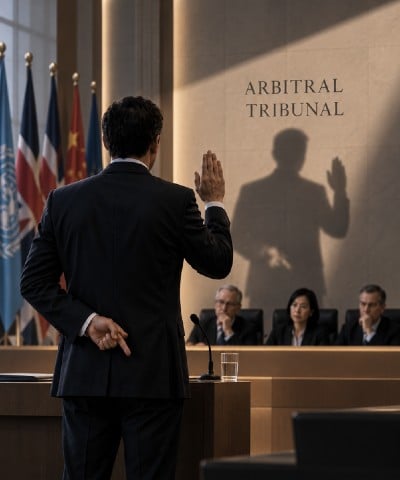 The consequences can extend well beyond the loss of credibility. Depending on the applicable law, deliberate false evidence may expose a witness to criminal liability, affect the tribunal’s assessment of the case and costs, and, in serious cases, provide a basis for challenging or resisting enforcement of an arbitral award.
There is, however, no uniform international offence of “perjury” applicable to arbitration. Some jurisdictions require sworn evidence, while others expressly extend offences concerning false testimony to arbitration or criminalise the fabrication of evidence intended to mislead an arbitrator.
1. What Constitutes Perjury or False Testimony in Arbitration?
Not every incorrect statement amounts to perjury. A witness may genuinely forget events, misunderstand a question or remember matters differently from another witness. The central distinction is generally between an honest mistake and a deliberate falsehood.
The precise requirements vary from jurisdiction to jurisdiction. In England and Wales, for example, Section 1 of the Perjury Act 1911 applies where a person lawfully sworn as a witness or interpreter in a judicial proceeding wilfully makes a material statement which the person knows to be false or does not believe to be true.[1]
Swiss law is broader in a different sense. Articles 306 and 307 of the Swiss Criminal Code concern false statements by parties and false evidence from witnesses, experts, translators and interpreters, while Article 309 expressly extends the relevant provisions to arbitration.[2]
It is also important to distinguish false testimony from fabricated evidence. A person may try to deceive a tribunal by creating or altering documents without ever giving false oral testimony. India and Singapore expressly criminalise the fabrication of evidence intended to appear before an arbitrator.[3]
Accordingly, the main questions are whether the evidence was false, whether the falsehood was deliberate, whether an oath or formal warning was required, and whether the statement was sufficiently material under the applicable law.
2. Who Can Commit Perjury or Give False Evidence in an Arbitration?
The most obvious category is a factual witness, such as a director, employee or consultant. A party may also face liability when personally giving evidence. Some jurisdictions distinguish between evidence given by a party and evidence given by a witness who is not a party. Switzerland, for example, regulates them separately under Articles 306 and 307 of its Criminal Code.[4]
Experts may also face liability where they knowingly invent data, falsify calculations or misrepresent the factual basis of an opinion. A genuine professional disagreement, however, is not false evidence merely because the tribunal prefers another expert’s view.
Translators and interpreters may also face liability if they deliberately distort a translation or interpretation.
The position is different for legal representatives. Advocacy is not testimony. A lawyer does not commit perjury merely because a submission proves incorrect. Knowingly creating, procuring or relying on false evidence, however, may raise professional, procedural and potentially criminal issues. The 2020 Rules of the London Court of International Arbitration (“LCIA”), for example, prohibit authorised representatives from knowingly making false statements or assisting with false evidence.[5]
The key question is therefore not only what was said, but who said it, in what capacity and under what legal duty.
3. Perjury and False Evidence Across Different Jurisdictions
3.1. Switzerland
Switzerland provides one of the clearest statutory links between false evidence and arbitration. Article 306 of the Swiss Criminal Code concerns false statements by a party who has been formally cautioned to tell the truth. Article 307 covers false testimony by witnesses, false expert reports or opinions, and false translations. Article 309 expressly applies these provisions to arbitral proceedings.[6]
A formal oath is not required for the basic Swiss offences. For a party’s false statement under Article 306, however, the party must have been expressly cautioned to tell the truth and notified of the criminal consequences; witnesses, experts, translators and interpreters are separately addressed by Article 307.
Swiss law also provides a direct post-award remedy. Under Article 190a(1)(b) of the Swiss Private International Law Act (“PILA”), an award may be revised where criminal proceedings establish that a felony or misdemeanour influenced the award to a party’s detriment. No criminal conviction is required, and where criminal proceedings cannot be conducted, the wrongdoing may be proved by other means.[7]
The Swiss Federal Supreme Court applied the same underlying principle in 4A_596/2008, where later criminal investigations established that the arbitral tribunal had been deceived, and the court ultimately granted the application for revision of the award.[8]
More recently, in 4A_268/2025, the Swiss Federal Supreme Court granted revision of an award of the Court of Arbitration for Sport (“CAS”) after criminal proceedings established that contracts and an email relied upon in the arbitration had been forged or fabricated. The criminal conduct had influenced the award to the applicant’s detriment, and the matter was referred back to CAS.[9]
3.2. England and Wales
In England and Wales, perjury is closely connected to sworn evidence. Section 1 of the Perjury Act 1911 applies where a person lawfully sworn as a witness or interpreter in a judicial proceeding wilfully makes a material statement known to be false or not believed to be true.[10]
The Act defines “judicial proceeding” broadly, while Section 38(5) of the Arbitration Act 1996 gives arbitral tribunals power to administer oaths and affirmations unless the parties agree otherwise.[11] Deliberately false sworn testimony in arbitration may therefore constitute perjury.
An ordinary unsworn witness statement, by contrast, does not automatically satisfy Section 1 merely because its contents are knowingly false.
At the award stage, Section 68(2)(g) of the Arbitration Act 1996 permits a challenge where an award was obtained by fraud, or where the award itself or the way it was procured is contrary to public policy. Section 68 applies only where the court considers that the irregularity has caused or will cause substantial injustice to the applicant. In Elektrim SA v Vivendi Universal SA, however, the Commercial Court stressed that false testimony does not automatically mean that an award was “obtained by fraud”. The fraud must be that of a party to the arbitration, or another person whose fraud the party was privy to, and there must be a causative link between the fraud and the decision in the award.[12]
3.3. France
France illustrates why the term “perjury” should be used cautiously.
Article 434-13 of the French Penal Code criminalises false testimony given under oath before a court.[13] However, arbitration in France ordinarily works differently. Article 1467 of the Code of Civil Procedure provides that witnesses before an arbitral tribunal are heard without an oath.[14]
Ordinary witness testimony in a French arbitration should therefore not automatically be characterised as criminal perjury under Article 434-13.
Nevertheless, French law provides an important post-award remedy. Articles 1502, 1506 and 595 of the Code of Civil Procedure permit revision of an arbitral award in circumstances including fraud, documents subsequently recognised or judicially declared false, or testimony subsequently judicially declared false.[15]
This makes France a good example of the distinction between criminal perjury and false evidence capable of undermining an arbitral award.
3.4. United Arab Emirates
The United Arab Emirates (“UAE”) position requires particular care because the arbitration and procedural framework differs between onshore UAE seats and arbitrations seated in the Dubai International Financial Centre (“DIFC”) or Abu Dhabi Global Market (“ADGM”). Federal UAE criminal law, however, continues to apply in the financial free zones.[16]
Article 302 of Federal Decree-Law No. 31 of 2021 criminalises false testimony given under oath before a judicial authority or other body competent to hear witnesses.[17]
For arbitration, this must be considered together with the procedural framework. Article 33(6) of the UAE Federal Arbitration Law addresses the manner in which witnesses and experts are heard, while institutional rules may also regulate oaths. Article 27.6 of the 2022 Arbitration Rules of the Dubai International Arbitration Centre (“DIAC”), for example, permits a tribunal to require an oral witness to swear an oath, subject to mandatory law at the seat.[18]
The Dubai Court of Cassation has confirmed that oath requirements can affect arbitral procedure. In Case No. 96/2022, an award was annulled where witnesses had not taken the oath required under the applicable institutional rules.[19] By contrast, in Case No. 1406/2023, the court did not treat the absence of an oath from a tribunal-appointed expert as a basis for annulment because Article 30 of the 2007 DIAC Rules did not require such an expert to take an oath. The court also relied on the party’s failure to object during the arbitration.[20]
These cases concern procedural validity rather than criminal liability. It would therefore be too broad to state that every deliberate false statement in an onshore UAE arbitration constitutes criminal perjury.
3.5. India
India distinguishes between giving false evidence and fabricating false evidence. Section 227 of the Bharatiya Nyaya Sanhita, 2023 addresses knowingly false evidence given by a person legally bound by an oath, an express provision of law or another legal obligation to state the truth.[21]
Section 228 is particularly significant for arbitration. It expressly covers fabricated circumstances, documents or electronic records intended to appear in evidence before an arbitrator and to cause an erroneous opinion on a material point.[22]
Indian law therefore extends beyond lies told during cross-examination. A deliberately fabricated email, ledger entry or other document intended to mislead a tribunal may itself amount to fabricating false evidence.
Fraud can also affect the award. Section 34 of the Arbitration and Conciliation Act, 1996 provides that an award may be set aside as contrary to the public policy of India where its making was induced or affected by fraud or corruption.[23]
Fraud may also affect enforcement of a foreign award in India: Section 48(2)(b), Explanation 1(i), provides that an award conflicts with the public policy of India where its making was induced or affected by fraud or corruption.[24]
3.6. Singapore
Singapore follows a similar distinction. Section 191 of the Penal Code concerns giving false evidence where a person is legally bound to state the truth. Section 192 expressly includes fabricated evidence intended to appear before an arbitrator.[25]
The International Arbitration Act 1994 (“IAA”) also empowers arbitral tribunals to administer oaths or take affirmations from parties and witnesses, unless the parties have agreed otherwise.[26]
Singapore’s courts have developed particularly useful jurisprudence on the effect of procedural fraud on awards. Section 24(a) of the IAA permits an award to be set aside where its making was induced or affected by fraud or corruption. In Bloomberry Resorts and Hotels Inc v Global Gaming Philippines LLC, the Court of Appeal confirmed that procedural fraud can include perjury, concealment of material information and suppression of evidence, but stressed that there must be a sufficient connection between the fraud and the making of the award.[27]
4. What Happens If False Testimony Is Discovered During the Arbitration?
If suspected false evidence is discovered while the arbitration is ongoing, the tribunal normally has considerable flexibility to address it.
The immediate question is usually evidentiary: Can the evidence be trusted?
The tribunal may permit further cross-examination, order additional documents, allow rebuttal evidence or compare the disputed testimony with contemporaneous records, and ultimately decide what weight to give the evidence.
Where applied, the 2020 IBA Rules on the Taking of Evidence in International Arbitration, issued by the International Bar Association, leave questions of admissibility, relevance, materiality and weight to the tribunal. They also permit the tribunal to take a party’s failure to act in good faith in the taking of evidence into account when allocating costs.[28]
A tribunal should nevertheless distinguish between an inconsistency and a deliberate lie. A witness changing an answer may affect credibility but does not automatically establish dishonesty. The same is true of expert evidence: rejecting an expert opinion does not mean the expert fabricated it. Where dishonest evidence has unnecessarily increased the cost of the arbitration, the conduct may also influence the costs decision.
The tribunal does not, however, ordinarily determine criminal guilt. It decides questions of evidence for the purposes of the arbitration. Whether a criminal offence has been committed is a matter for the competent national authorities.
5. Can Perjury Affect the Arbitral Award?
5.1. Discovery Before the Award
Where suspected false evidence emerges before the award, the issue should generally be raised promptly.
The allegation should identify the particular statement or document, explain why it is false and provide supporting evidence. The other side should normally have an opportunity to respond.
If deliberate falsehood is established, the tribunal should take it into account when assessing credibility, deciding the merits and allocating costs.
5.2. Discovery After the Award
Once an award has been rendered, the position is more difficult. A party generally cannot reopen an arbitration simply because it has discovered evidence contradicting a witness. Post-award remedies are deliberately narrow.
The central questions usually include whether the evidence was deliberately false, whether the issue could reasonably have been discovered earlier, whether the false evidence was material, whether it affected the award and whether the applicable time limit has been respected.
Both Elektrim and Bloomberry demonstrate the central point that proving that a witness lied is not the same thing as proving that the award should be set aside.[29]
5.3. Setting Aside or Revision
Different jurisdictions provide different mechanisms for setting aside or revising awards affected by perjury or other false evidence. In Switzerland, Article 190a(1)(b) of PILA permits revision where criminal conduct influenced the award.[30]
In France, Articles 595, 1502 and 1506 of the Code of Civil Procedure specifically permit revision in cases involving fraud or subsequently established false documents or testimony.[31]
In England and Wales, Section 68(2)(g) of the Arbitration Act 1996 permits a challenge where an award was obtained by fraud or where the award or the way it was procured is contrary to public policy.[32] A prominent modern example is Federal Republic of Nigeria v Process & Industrial Developments Ltd, where Process & Industrial Developments Ltd had obtained arbitral awards of approximately USD 6.6 billion plus interest, with Nigeria’s potential liability exceeding USD 11 billion by the time of the English court proceedings. The Commercial Court found extensive misconduct affecting the arbitration, including reliance on evidence known to be false and other fraudulent conduct. It concluded that the awards had been obtained by fraud and that their procurement was contrary to public policy. In a subsequent ruling of 21 December 2023, the court ordered that the awards be set aside rather than remitted to the tribunal.[33]
In Singapore, Section 24(a) of the IAA permits an award to be set aside where its making was induced or affected by fraud or corruption.[34] In India, fraud affecting the making of an award may engage the public-policy ground under Section 34 of the Arbitration and Conciliation Act, 1996.[35]
Across several of these systems, post-award relief requires a material connection between the misconduct and the award, although the statutory test and additional requirements differ by jurisdiction.
5.4. Enforcement Issues
False evidence may also be a major issue when enforcement of the award is sought. The New York Convention contains no separate defence labelled “perjury”. The issue must fall within one of the grounds in Article V.[36]
The most relevant ground in a serious fraud case is often Article V(2)(b), which allows enforcement to be refused where recognition or enforcement would violate the public policy of the enforcing state.[37] Enforcement proceedings are not, however, an appeal on witness credibility.
The Singapore Court of Appeal’s 2026 decision in ONI Global Pte Ltd v GNC Holdings LLC illustrates this point. The underlying tribunal knew that potentially relevant evidence had been destroyed and had already considered the consequences. The Court of Appeal held that an enforcement court should exercise the “greatest caution possible” before reopening a procedural-fraud issue already considered by the tribunal.[38]
The question is therefore not simply whether misconduct occurred, but whether it affected the making of the award in a manner serious enough to engage the applicable enforcement defence.
6. Comparative Overview
| Jurisdiction | Legal Position | Oath/Procedural Requirements | Potential effect on the award |
| Switzerland | False statements by parties and false evidence from witnesses, experts, translators and interpreters are expressly capable of engaging criminal liability in arbitral proceedings under Articles 306-309 of the Swiss Criminal Code. | A formal oath is not required. For a party’s statement under Article 306, the party must have been cautioned to tell the truth and informed of the criminal consequences. | Article 190a(1)(b) of PILA permits revision where criminal proceedings establish that a felony or misdemeanour influenced the award to the applicant’s detriment. |
| England and Wales
| Section 1 of the Perjury Act 1911 covers a material statement wilfully made by a lawfully sworn witness or interpreter who knows it is false or does not believe it to be true. | Sworn evidence is central to the offence. Unless the parties agree otherwise, Section 38(5) of the Arbitration Act 1996 empowers the tribunal to administer oaths and affirmations.
| Section 68(2)(g) permits a challenge for fraud or public-policy irregularity, subject to the statutory requirement of substantial injustice. A fraud-based challenge also requires the necessary connection between the fraud and the award. |
| France | Article 434-13 of the Penal Code criminalises false testimony given under oath before a court. Ordinary testimony before an arbitral tribunal therefore does not automatically fall within this offence. | Article 1467 of the Code of Civil Procedure provides that persons heard by an arbitral tribunal are ordinarily heard without taking an oath.
| Revision may be available for fraud, reliance on documents subsequently recognised or judicially declared false, or reliance on testimony subsequently judicially declared false, subject to the applicable conditions. |
| UAE | Article 302 of the Crimes and Penalties Law criminalises false testimony delivered under oath before a judicial authority or other body competent to hear witnesses. | Whether an oath is required in arbitration depends on the applicable procedural framework and institutional rules. Failure to comply with an applicable oath requirement may affect the validity of the proceedings. | Non-compliance with applicable witness requirements may provide a basis for challenging an award, depending on the circumstances and applicable rules.
|
| India | Sections 227-229 of the Bharatiya Nyaya Sanhita, 2023 address giving and fabricating false evidence. Section 228 expressly covers fabricated evidence intended to appear before an arbitrator. | Giving false evidence under Section 227 requires a legal obligation to tell the truth or make a declaration. Fabricating false evidence under Section 228 does not depend on an oath. | Fraud affecting the making of an award may support setting aside under Section 34 of the Arbitration and Conciliation Act, 1996 and may also affect enforcement of a foreign award under Section 48. |
| Singapore | Sections 191-193 of the Penal Code address giving and fabricating false evidence. Section 192 expressly includes fabricated evidence intended to appear before an arbitrator. | The International Arbitration Act 1994 permits arbitral tribunals to administer oaths or take affirmations unless the parties have agreed otherwise. | Section 24(a) of the International Arbitration Act 1994 permits setting aside where the making of the award was induced or affected by fraud or corruption. Procedural fraud must have the required connection with the making of the award. |
Conclusion
Arbitration does not place witnesses beyond the reach of applicable national criminal law. There is nevertheless no single international rule on perjury in arbitration. Switzerland expressly extends its false-evidence offences to arbitral proceedings. England and Wales focus closely on sworn testimony. French arbitral witnesses ordinarily testify without oath, although French law provides a specific revision remedy where false evidence later emerges. India and Singapore expressly address evidence fabricated for use before an arbitrator. In onshore UAE arbitrations, the applicable oath requirements and procedural framework require particular attention.
The consequences within an arbitration are also distinct from criminal liability. A tribunal may reject unreliable evidence, permit further examination and take dishonest evidentiary conduct into account when deciding costs, but it does not ordinarily determine criminal guilt. Most importantly, false testimony does not automatically invalidate an arbitral award. In many jurisdictions, courts require a serious and material connection between the misconduct and the making of the award, although the precise statutory test differs.
However, the practical lesson is simple: a witness should not assume that lying in a private arbitration is less serious than lying in court, because deliberate false evidence can have serious criminal, procedural and post-award consequences.
[1] Perjury Act 1911, s. 1.
[2] Swiss Criminal Code of 21 December 1937 (SR 311.0), Arts. 306-309.
[3] Bharatiya Nyaya Sanhita, 2023 (Act No. 45 of 2023), ss. 228-229; Penal Code 1871 (2020 Rev Ed), ss. 192-193.
[4] Swiss Criminal Code of 21 December 1937 (SR 311.0), Arts. 306-307.
[5] 2020 LCIA Arbitration Rules, Art. 18.6 and Annex, paras. 3-4, 7.
[6] Swiss Criminal Code of 21 December 1937 (SR 311.0), Arts. 306-309.
[7] Swiss PILA, Art. 190a(1)(b).
[8] Swiss Federal Supreme Court, 4A_596/2008 of 6 October 2009.
[9] Swiss Federal Supreme Court, 4A_268/2025 of 22 October 2025, consids. 4.1.2, 6.
[10] Perjury Act 1911, s. 1(1).
[11] Perjury Act 1911, s. 1(2); Arbitration Act 1996, ss. 38(2), 38(5).
[12] Arbitration Act 1996, s. 68(2)(g); Elektrim SA v Vivendi Universal SA [2007] EWHC 11 (Comm) [79]-[83], [120].
[13] French Penal Code, Art. 434-13.
[14] French Code of Civil Procedure, Arts. 1467, 1506.
[15] French Code of Civil Procedure, Arts. 595-596, 1502, 1506.
[16] Federal Law No. 8 of 2004 Concerning Financial Free Zones, Art. 3(2).
[17] Federal Decree-Law No. 31 of 2021 Promulgating the Crimes and Penalties Law, Art. 302 (UAE).
[18] Federal Law No. 6 of 2018 on Arbitration, Art. 33(6) (UAE); 2022 DIAC Arbitration Rules, Art. 27.6.
[19] Dubai Court of Cassation, Case No. 96/2022 (Civil), 2 June 2022.
[20] Dubai Court of Cassation, Case No. 1406/2023 (Commercial), 28 November 2023.
[21] Bharatiya Nyaya Sanhita, 2023 (Act No. 45 of 2023), s. 227.
[22] Bharatiya Nyaya Sanhita, 2023 (Act No. 45 of 2023), ss. 228-229.
[23] Arbitration and Conciliation Act, 1996 (Act No. 26 of 1996), s. 34(2)(b)(ii), Explanation 1.
[24] Arbitration and Conciliation Act, 1996 (Act No. 26 of 1996), s. 48(2)(b), Explanation 1(i).
[25] Penal Code 1871 (2020 Rev Ed), ss. 191-193.
[26] International Arbitration Act 1994 (2020 Rev Ed), s. 12(2).
[27] Bloomberry Resorts and Hotels Inc v Global Gaming Philippines LLC [2021] SGCA 9 [41]-[42].
[28] 2020 IBA Rules on the Taking of Evidence in International Arbitration, Arts. 9.1, 9.8.
[29] Elektrim SA v Vivendi Universal SA [2007] EWHC 11 (Comm) [120]; Bloomberry Resorts and Hotels Inc v Global Gaming Philippines LLC [2021] SGCA 9 [41]-[42].
[30] Swiss PILA, Art. 190a(1)(b).
[31] French Code of Civil Procedure, Arts. 595, 1502, 1506.
[32] Arbitration Act 1996, s. 68(2)(g).
[33] Federal Republic of Nigeria v Process & Industrial Developments Ltd [2023] EWHC 2638 (Comm) [4], [493]-[496], [574], [577]; Federal Republic of Nigeria v Process & Industrial Developments Ltd [2023] EWHC 3320 (Comm) [3]-[4].
[34] International Arbitration Act 1994 (2020 Rev Ed), s. 24(a).
[35] Arbitration and Conciliation Act, 1996 (Act No. 26 of 1996), s. 34(2)(b)(ii), Explanation 1.
[36] Convention on the Recognition and Enforcement of Foreign Arbitral Awards, signed 10 June 1958 (“New York Convention”), Art. V.
[37] New York Convention, Art. V(2)(b).
[38] ONI Global Pte Ltd v GNC Holdings LLC [2026] SGCA(I) 3 [50]-[51].