Construction delay disputes are rarely straightforward. A project may finish months behind schedule, but that fact alone does not reveal which event caused the critical delay, which party bore the relevant risk, or what remedy should follow. The contractor may claim an extension of time and prolongation costs, while the employer seeks liquidated damages for the very same period. In arbitration, the dispute often becomes even more complex, as each side may rely on a different programme, a different delay analysis methodology and a different interpretation of the governing law.[1]
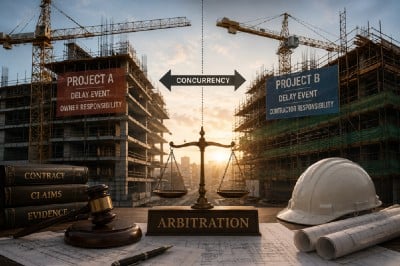 The problem is most difficult when employer-risk and contractor-risk events overlap. This is called concurrent delay. Although concurrency is cited in many major construction disputes, genuine concurrent delay is rare. Modern delay analysis often shows that events overlapped in time but did not both delay completion or that one event was clearly more causative. Many such disputes are resolved in confidential arbitration, which explains the limited published authority outside a few jurisdictions.[2]
This note explains the legal and evidential framework for construction delay claims, highlights the challenges posed by concurrency, and reviews key approaches in major common-law and civil-law jurisdictions. These differences have significant practical consequences in international arbitration, where the same delay scenario may produce very different results depending on the governing law, the contractual allocation of risk and the tribunal’s approach to causation.
1. From Project Delay to Legal Entitlement
A delay to an individual activity does not necessarily affect the project completion date. A delay to the start of an activity may simply reduce available float rather than affect the contractual completion date.[3] Conversely, delay to a critical activity may move the completion date even if most of the works continue. The first task is therefore to identify whether the alleged event affected the critical path and, if so, for how long.
The second task is contractual classification. Construction contracts usually allocate delay events among three broad categories:
- Employer-risk events, such as late site access, delayed drawings, variations or interference by other contractors, may entitle the contractor to an extension of time and sometimes compensation.
- Contractor-risk events, such as inadequate labour, defective work, procurement failures or poor sequencing, normally provide no extension and may expose the contractor to liquidated damages.
- Neutral events, including some force majeure events or exceptionally adverse weather, may provide time but not money.
The terminology is useful, but the outcome will depend primarily on the terms of the contract.[4]
Extensions of time and monetary compensation must be analysed separately. An extension protects the contractor from liquidated damages by moving the contractual completion date. Prolongation compensation reimburses qualifying time-related costs, such as extended site overheads, plant, supervision and insurance. A contractor may therefore receive time without money. Equally, a compensable disruption may increase cost without delaying the completion date.[5]
In common-law systems, an effective extension-of-time mechanism also protects the employer. Where the employer causes delay but the contract contains no effective mechanism for extending the completion date, the prevention principle may apply. In that case, the original completion date may cease to be binding, time may become “at large”, and the contractor will instead be required to complete the works within a reasonable period. The employer may also lose the right to rely on the contractual liquidated damages regime. This is why both parties benefit from clearly drafted delay provisions, notice requirements and mechanisms for assessing extensions of time.[6]
2. Why Delay Analysis Is Technically Difficult
2.1 The Critical Path Is Dynamic
The critical path is the sequence of linked activities that determines the overall project duration. It is not necessarily fixed. An activity that had float in the baseline programme may become critical after earlier delay, resequencing or resource constraints. An originally critical activity may cease to drive completion. A reliable analysis must therefore consider the programme and actual progress at the relevant time, rather than simply comparing the baseline completion date with the eventual completion date.[7]
The quality of the programme is often the first major evidential dispute.[8] The baseline may contain unrealistic durations, weak or missing logic, excessive constraints or unexplained contingency. Later updates may fail to reflect actual progress, introduce changes to logic or sequence without explanation, or simply provide an unreliable picture of how the works were progressing. The dispute is therefore not just about running delay events through scheduling software. It is also about whether the programme genuinely records the contractor’s original plan, how that plan changed as the project developed, and what actually happened on site.
2.2 No Methodology Is Universally Correct
Common methods include:
- impacted as-planned analysis;
- time impact analysis;
- time-slice or windows analysis;
- as-planned versus as-built analysis;
- retrospective longest-path analysis; and
- collapsed as-built analysis.
Each answers a slightly different question and depends on different records. A prospective assessment during the project may properly use information and forecasts then available. A retrospective assessment after completion can test what actually drove the as-built critical path. The most suitable method depends on the contract, the events, project complexity, available programmes and records, the forum, proportionality and the time and cost of the exercise.[9]
Modelled techniques can identify the theoretical impact of events, but their output is only as reliable as the logic, assumptions and updates selected by the analyst. Fact-based techniques can be persuasive because they begin with actual execution, but they require comprehensive contemporaneous records. In both cases, a model can create false precision. Delay analysis is rarely accurate to a single day, and tribunals commonly test its conclusions against contemporaneous facts and commercial common sense.[10]
2.3 Causation and Proof Remain Legal Questions
Delay experts assist the tribunal, but they do not determine legal entitlement. The contractor generally must prove the occurrence of a qualifying event, contractual entitlement, critical causation and the resulting loss. The employer may respond that the event was non-critical, absorbed by float, overtaken by contractor delay, inadequately notified or unrelated to the costs claimed.[11]
The evidential burden becomes particularly difficult in global claims, where numerous events are said collectively to have caused an overall overrun or cost increase. English authority does not treat a global claim as inherently impermissible, but the claimant still must establish the relevant events, causation and loss on the balance of probabilities, and account for contractor-responsible causes or tender deficiencies. A tribunal may make a reasoned estimate where exact calculation is impossible, but that does not relieve the claimant of the need to prove entitlement, causation and loss.[12]
This makes contemporaneous records particularly important. Accepted and updated programmes, progress reports, daily records, labour and plant returns, design registers, instructions, requests for information, meeting minutes, photographs, cost ledgers and correspondence can reveal what was actually preventing progress. A project witness with direct knowledge, supported by reliable records, may be more compelling than an expert retained years later who must reconstruct events from incomplete data.[13]
3. Concurrent Delay: A Narrow Concept with Major Consequences
Concurrent delay generally exists where at least two independent events are effective causes of delay to completion, one allocated to the employer and one to the contractor, and their critical effects operate during the same period. The events themselves do not always need to begin on the same day. What matters is whether each event independently affects the critical path and delays completion. “True” concurrency, in the stricter SCL Protocol sense, requires both the events and their effects to occur at the same time and is particularly rare.[14]
A simple example illustrates the issue. Suppose the employer fails to obtain an excavation permit, while the contractor also fails to mobilise the necessary excavator. Either failure would independently prevent excavation and delay completion by ten days. Critical path analysis can identify the affected activity, but it cannot by itself decide whether the contractor receives an extension, whether either party recovers money, or whether responsibility should be apportioned. Those consequences depend on the contract and governing law.[15]
In practice, three broad approaches tend to emerge. Under the first, the contractor receives an extension of time for the full concurrent period but cannot recover prolongation costs, while the employer cannot claim liquidated damages. This is often described as “time but not money”. A second approach apportions both time and financial consequences according to the relative impact or responsibility of each delay. A third, more flexible approach grants the contractor a full extension of time but allows recovery only for those costs that can be shown to result from the employer’s delay alone.[16]
The SCL Protocol adopts the first approach for time and a separability test for money. Once concurrency is established, contractor delay should not reduce the extension due for employer delay. For compensation, however, the contractor should recover only loss and expense that can be separated from costs it would have incurred because of its own delay. The Protocol is widely used as a practical guide, but it is not binding and cannot override the contract or governing law.[17]
4. Comparative Approaches to Concurrent Delay
4.1 England and Wales: Time but Not Money
The practical English rule remains the Malmaison approach. Where an employer-risk event and a contractor-risk event are both effective causes of the same critical delay, the contractor is ordinarily entitled to the full extension generated by the relevant employer event. The contractor is generally not entitled to prolongation costs for the concurrent period because it would have incurred those costs in any event as a result of its own delay. Correspondingly, the extension removes the employer’s entitlement to liquidated damages for that period.[18]
This approach was accepted in Henry Boot Construction (UK) Ltd v Malmaison Hotel (Manchester) Ltd, endorsed in De Beers UK Ltd v Atos Origin IT Services UK Ltd and applied in Walter Lilly & Co Ltd v Mackay. In Walter Lilly, the Technology and Construction Court rejected Scottish-style apportionment under the contractual wording before it and held that a relevant event which was an effective cause justified a full extension. More recent first-instance authority has described the time-and-money distinction as settled, while recognising that the precise contract remains decisive.[19]
There is nevertheless an important qualification. In North Midland Building Ltd v Cyden Homes Ltd, the Court of Appeal enforced bespoke wording under which concurrent contractor delay reduced the extension otherwise available. The decision confirms that parties may expressly allocate the risk of concurrent delay and that clear contractual wording will not be displaced by the prevention principle. It does not, however, settle every aspect of the position under unamended standard forms. In English-law arbitrations, Malmaison therefore remains the usual starting point, but the wording of the particular contract must always be considered first.[20]
4.2 Scotland: Apportionment
Scots law takes a materially different approach. In John Doyle Construction Ltd v Laing Management (Scotland) Ltd, the Inner House accepted that loss caused by truly concurrent events could be apportioned according to their relative significance. In City Inn Ltd v Shepherd Construction Ltd, the Scottish courts extended this reasoning to extensions of time, permitting a fair and reasonable allocation based on causative potency and culpability.[21]
The result can be a partial extension, partial prolongation recovery and partial liquidated-damages exposure. This avoids an all-or-nothing answer, but it gives the decision-maker substantial evaluative discretion. The expert evidence must therefore address not only whether both events were critical, but also their relative effect and the factual basis for any proposed percentage or period of allocation.[22]
4.3 United States and Canada
United States authority is extensive but not entirely uniform across federal and state systems. The general rule is nevertheless similar to the English outcome: concurrent employer and contractor delay is excusable but non-compensable. The contractor receives time and protection from liquidated damages, but each party ordinarily bears its own delay costs unless the evidence permits a clear apportionment.[23]
Canadian authority remains limited, but the Ontario decision in Schindler Elevator Corporation v Walsh Construction Company of Canada points towards a practical form of apportionment. The court rejected the idea that concurrent delays must have identical start and finish dates and favoured a realistic assessment of overlapping, co-critical delay and proportionate responsibility. The outcome is more fact-sensitive than the standard English formulation and depends heavily on reliable critical-path evidence.[24]
4.4 Hong Kong, Singapore and Australia
Hong Kong traditionally drew heavily on English construction law, but W Hing Construction Co Ltd v Boost Investments Ltd expressed support, in obiter reasoning, for the Scottish apportionment approach. It is therefore a useful indication of the Hong Kong courts’ approach, but it does not establish a settled or comprehensive rule.
In Singapore, PPG Industries (Singapore) Pte Ltd v Compact Metal Industries Ltd supports apportioning delay-related loss by ordinary causation principles where other events contributed to the overrun, although it does not establish a comprehensive doctrine governing concurrent delay in Singapore.[25]
Australia has relatively little general case law on concurrent delay, partly because many widely used standard forms deal with the issue expressly. Some deny an extension of time where contractor delay runs concurrently with an employer event, while others allow the consequences to be apportioned. In practice, the wording of the contract often decides the issue before any default legal rule needs to be considered. This shows why, on international projects, project-specific amendments may matter more than the jurisdiction’s general approach.[26]
4.5 Civil-Law Europe: General Codes, Limited Specific Authority
Civil-law jurisdictions rarely contain a provision labelled “concurrent delay”. Tribunals instead work from general rules on contractual performance, good faith, creditor contribution, causation, damages and contractual penalties.
Italian commentary suggests that the Civil Code allows responsibility to be divided where both the employer and the contractor contribute to the delay. Rules on equitable assessment of damages, contributory conduct by the creditor and the reduction of contractual penalties may all support an apportioned result. This approach differs from the traditional English resistance to apportionment in purely contractual claims, although the precise result remains dependent on the contract and proof.[27]
Switzerland has no developed or generally accepted concurrent-delay jurisprudence. Scholars disagree on whether an employer-risk event should automatically justify an extension despite the contractor’s inability to perform, or whether the contractor must show that it was ready and able to benefit from the employer’s required cooperation. Swiss law permits contractual allocation of the risk, requires proof of causation, and allows reduction of damages where the injured party contributed to the loss. Available commentary tends towards time without money in some factual settings, but no universal rule can safely be stated.[28]
Germany and France are similarly underdeveloped on the specific issue. German analysis may draw on good faith, contributory responsibility and strict proof of the actual construction sequence. French law may support apportionment through good-faith performance and the principle that compensation corresponds to the loss actually caused. In both systems, the absence of a dedicated rule makes the contract and tribunal’s causation analysis especially important.[29]
4.6 The Middle East: Scope for Apportionment, but No Uniform Rule
The civil codes of the United Arab Emirates, Egypt and Qatar do not expressly regulate concurrent construction delay. Their general provisions nevertheless provide arguments for apportionment. Good-faith performance, direct causation, the creditor’s contribution to harm and judicial power to adjust agreed damages can prevent either party from recovering loss caused by its own conduct. These principles may support a partial extension, reduced liquidated damages or partial cost recovery, but accessible case law remains sparse and alternative arguments for time without money can also be made.[30]
Saudi Arabia requires an updated qualification. The Civil Transactions Law, enacted in 2023, now codifies general contractual rules and a dedicated regime for contracts for services, including construction. It does not, however, establish an express concurrent-delay rule. Saudi-law tribunals are therefore likely to begin with the agreed risk allocation and apply the Law’s general rules on performance, good faith, causation, compensation and contribution, together with applicable Sharia principles where the statute leaves a gap.[31]
4.7 India and Selected Latin American Jurisdictions
India has no settled legal position on concurrent delay. In the absence of specialised construction legislation, construction contracts are governed primarily by the Indian Contract Act, 1872, the parties’ agreed terms and other generally applicable legislation. Recent commentary notes that courts and tribunals have sometimes denied the contractor additional costs while also refusing to award the employer liquidated damages. This produces an outcome similar to “time but not money”, although it is not yet a uniform rule.[32]
In Latin America, the position is also fragmented. Brazilian law addresses concurrent fault in general damages terms, allowing indemnification to reflect the parties’ comparative fault, but the courts have not established a construction-specific concurrency doctrine. Peruvian public-project rules generally do not address the issue, while private disputes may draw on foreign authority. Mexican law is reported to be silent. These jurisdictions show why international tribunals should not simply apply an English or Scottish approach without first considering the principles of the law governing the contract.[33]
5. How Arbitral Tribunals Should Approach Delay Claims
A tribunal faced with a construction delay claim should separate five questions:
- First, what does the contract define as the completion obligation, the relevant delay events and the consequences of notice?
- Second, which activities actually controlled completion during each material period?
- Third, did the alleged event cause critical delay, or merely coincide with it?
- Fourth, how does the governing law treat competing effective causes?
- Fifth, which losses were caused by the compensable event and would not otherwise have been incurred?
It is important to keep the technical and legal questions separate. The delay expert can explain which activities were critical, assess the effect of particular events and test competing scenarios. The tribunal must then decide what the contract required, whether the relevant causation test is met, whether notice requirements were satisfied and what legal consequences follow from any concurrent delay.
Efficient case management can materially improve the process. The tribunal may require the parties to identify their delay events and periods in a common chronology, disclose native programme files and logic reports, agree a glossary, and explain why their chosen methodologies are appropriate. A joint statement can help narrow the issues by showing exactly where the experts agree and where they differ, whether on the underlying data, programme logic, critical path or legal assumptions. Where experts use incompatible methods, an early procedural conference may prevent two expensive analyses from passing each other without answering the same question.[34]
A tribunal does not need perfect mathematical precision, but it does need sufficient proof. Project events cannot always be reconstructed down to the exact day, so some reasonable estimation may be unavoidable. Even then, any award must be grounded in the evidence and supported by a clear explanation of causation. The most persuasive claims usually link each delay event to a timely notice, its effect on the programme, the contemporaneous site records and the specific loss said to have followed.
6. Practical Lessons for Contract Drafting and Project Management
The most reliable way to reduce concurrency disputes is to address them before they arise. The contract should define concurrent delay, specify whether simultaneous occurrence or only simultaneous critical effect is required, and state the consequences for extensions, prolongation costs and liquidated damages. It should also address float, programme approval, update frequency, mitigation, acceleration, pacing, neutral events and the treatment of employer events arising during existing contractor delay. This is especially important because widely used FIDIC and JCT forms do not provide a complete express regime for concurrent delay.[35]
Parties should avoid a clause that deals only with time while leaving money unresolved. They should also test whether the wording works with the prevention principle, the liquidated-damages clause and the contract administrator’s powers. Under governing laws that respect freedom of contract, a clear clause is likely to displace uncertain default rules.
During the project, the contractor should keep the programme properly updated, give notices when required and record how each event affected the works. The employer should maintain its own progress records and deal with extension-of-time applications as they arise. Both parties should document mitigation and any decision to pace, resequence or accelerate. By the time arbitration begins, the quality of this record often determines whether the tribunal sees genuine concurrency, sequential delay, a dominant cause or no critical employer delay at all.
Conclusion
Construction delay disputes are difficult because the tribunal must bring together the contract, what actually happened on site, the experts’ analysis and the applicable law. Concurrent delay adds another layer of complexity, but it does not arise simply because two events occurred at the same time. The real question is whether both events delayed completion and, if so, how the contract and governing law allocate the consequences.
The comparative landscape remains divided. England and much of the United States generally favour time but not money; Scotland favours apportionment; other common-law jurisdictions adopt mixed positions; and many civil-law systems have no developed construction-specific rule. For international projects, precise drafting and disciplined contemporaneous evidence therefore offer more certainty than reliance on any supposedly universal doctrine.
[1] J. Jenkins, International Construction Arbitration Law (3rd edn., 2021), pp. 40-41, 266-277; K. Rosenberg, Concurrent Delay: What Is All the Fuss About?, 34(1) Const. L.J. 3, pp. 3-4.
[2] K. Rosenberg, Concurrent Delay: What Is All the Fuss About?, 34(1) Const. L.J. 3, pp. 3-7; E. Webb, Concurrent Delays in International Construction: Do You Really Want to Go Back to Kansas?, 33(3) Const. L.J. 219, pp. 219-221; G. Crossley and S. Widdowson, Concurrent Delay: Focus on Southeast Asia, Navigant, pp. 1-3; J. Jenkins, International Construction Arbitration Law (3rd edn., 2021), pp. 274-277.
[3] J. Jenkins, International Construction Arbitration Law (3rd edn., 2021), pp. 40 and 267-268; Society of Construction Law, Delay and Disruption Protocol (2nd edn., February 2017) (“SCL Protocol”), Appendix A, definitions of “critical delay”, “critical path” and “float”.
[4] L. Di Paola and P. Spanu, Concurrent Delays, 23 Intl. Constr. L. Rev. 373, pp. 375-376; SCL Protocol, Appendix A.
[5] SCL Protocol, Core Principles 12 and 14; J. Jenkins, International Construction Arbitration Law (3rd edn., 2021), p. 41.
[6] J. Jenkins, International Construction Arbitration Law (3rd edn., 2021), pp. 39-40; E. Webb, Concurrent Delays in International Construction: Do You Really Want to Go Back to Kansas?, 33(3) Const. L.J. 219, pp. 221-222.
[7] J. Jenkins, International Construction Arbitration Law (3rd edn., 2021), pp. 266-270; SCL Protocol, Appendix A, definition of “critical path”.
[8] SCL Protocol, Core Principle 1, paras. 1.43-1.47, 1.58-1.60, 4.9, 4.14 and 11.2-11.6; J. Jenkins, International Construction Arbitration Law (3rd edn., 2021), pp. 266-270.
[9] SCL Protocol, §§ 11.3-11.7; J. Jenkins, International Construction Arbitration Law (3rd edn., 2021), pp. 271-274; Z. Kilgore and M. Khedr, Concurrent Delay in the Complex World of Construction Projects, Global Arbitration Review, 23 July 2026, pp. 6-7.
[10] SCL Protocol, §§ 10.11 and 11.3; Z. Kilgore and M. Khedr, Concurrent Delay in the Complex World of Construction Projects, Global Arbitration Review, 23 July 2026, pp. 6-7.
[11] V.A. Ramsey, Problems of Delay and Disruption Damages in International Construction Arbitration, in Y. Derains and R. Kreindler (eds.), Evaluation of Damages in International Arbitration, ICC Dossier No. 4 (2006), pp. 193-199; E. Webb, Concurrent Delays in International Construction: Do You Really Want to Go Back to Kansas?, 33(3) Const. L.J. 219, pp. 223-229; SCL Protocol, Core Principles 3, 8, 10, 12 and 14.
[12] Walter Lilly & Co Ltd v Mackay [2012] EWHC 1773 (TCC), [2012] B.L.R. 503, para. 486; G. Grewal and A. Young, Walter Lilly & Company Ltd v (1) Mackay and (2) DMW Developments Ltd: Clarification of the Law on Concurrent Delays in English Law Construction Contracts, Dentons, 25 July 2012, pp. 2-3 of the PDF.
[13] J. Jenkins, International Construction Arbitration Law (3rd edn., 2021), pp. 265-267; SCL Protocol, Core Principle 1 and Appendix B.
[14] SCL Protocol, §§ 10.3-10.5; K. Rosenberg, Concurrent Delay: What Is All the Fuss About?, 34(1) Const. L.J. 3, pp. 4-7; R. Whelan and E. Kemp, Comparative Approaches to Concurrent Delay, in The Guide to Construction Arbitration (6th edn., 2026), Sections “What Is Concurrent Delay” and “Summary”.
[15] L. Di Paola and P. Spanu, Concurrent Delays, 23 Intl. Constr. L. Rev. 373, pp. 373-375.
[16] K. Rosenberg, Concurrent Delay: What Is All the Fuss About?, 34(1) Const. L.J. 3, pp. 7-18; R. Whelan and E. Kemp, Comparative Approaches to Concurrent Delay, in The Guide to Construction Arbitration (6th edn., 2026), Section “Comparative Approaches to Concurrent Delay”.
[17] SCL Protocol, §§ 10.12-10.16 and 14.3.
[18] Henry Boot Construction (UK) Ltd v Malmaison Hotel (Manchester) Ltd (1999) 70 Con. L.R. 32, para. 13; De Beers UK Ltd v Atos Origin IT Services UK Ltd [2010] EWHC 3276 (TCC), [2011] B.L.R. 274, para. 177.
[19] Walter Lilly & Co Ltd v Mackay [2012] EWHC 1773 (TCC), [2012] B.L.R. 503, para. 370; Thomas Barnes & Sons plc (In Administration) v Blackburn with Darwen Borough Council [2022] EWHC 2598 (TCC), para. 118; R. Whelan and E. Kemp, Comparative Approaches to Concurrent Delay, in The Guide to Construction Arbitration (6th edn., 2026), Section “England”.
[20] North Midland Building Ltd v Cyden Homes Ltd [2018] EWCA Civ 1744, paras. 22-23 and 31-38; R. Whelan and E. Kemp, Comparative Approaches to Concurrent Delay, in The Guide to Construction Arbitration (6th edn., 2026), Section “England”.
[21] John Doyle Construction Ltd v Laing Management (Scotland) Ltd 2004 S.C. 713, paras. 16-19; City Inn Ltd v Shepherd Construction Ltd [2010] CSIH 68, 2011 S.C. 127, para. 42.
[22] K. Rosenberg, Concurrent Delay: What Is All the Fuss About?, 34(1) Const. L.J. 3, pp. 10-11; City Inn Ltd v Shepherd Construction Ltd [2010] CSIH 68, 2011 S.C. 127, para. 42.
[23] R.P. Wallace, Inc. v. United States, 63 Fed. Cl. 402, 410-411 (2004); Pittman Construction Co. v. United States, 2 Cl. Ct. 211, 217 (1983); K. Rosenberg, Concurrent Delay: What Is All the Fuss About?, 34(1) Const. L.J. 3, pp. 11-12.
[24] Schindler Elevator Corporation v Walsh Construction Company of Canada, 2021 ONSC 283, paras. 346-348; K. Rosenberg, Concurrent Delay: What Is All the Fuss About?, 34(1) Const. L.J. 3, pp. 12-13.
[25] W Hing Construction Co Ltd v Boost Investments Ltd [2009] 2 HKLRD 501, para. 61; PPG Industries (Singapore) Pte Ltd v Compact Metal Industries Ltd [2013] SGCA 23, paras. 4, 9 and 11; R. Whelan and E. Kemp, Comparative Approaches to Concurrent Delay, in The Guide to Construction Arbitration (6th edn., 2026), Sections “Hong Kong” and “Singapore”.
[26] Rosenberg, pp. 13 and 18; E. Webb, Concurrent Delays in International Construction: Do You Really Want to Go Back to Kansas?, 33(3) Const. L.J. 219, pp. 230-233; CMS, CMS Expert Guide to the Law and Regulation of Concurrent Delay, Law and Regulation of Concurrent Delay in Australia, July 2020, pp. 4-7.
[27] Di Paola and Spanu, pp. 381-385; Italian Civil Code, Arts. 1226, 1227 and 1384.
[28] CMS, CMS Expert Guide to the Law and Regulation of Concurrent Delay, Law and Regulation of Concurrent Delay in Switzerland, July 2020, pp. 49-51; Swiss Code of Obligations, Art. 44(1); K. Rosenberg, Concurrent Delay: What Is All the Fuss About?, 34(1) Const. L.J. 3, pp. 13-14.
[29] K. Rosenberg, Concurrent Delay: What Is All the Fuss About?, 34(1) Const. L.J. 3, pp. 13-15; R. Whelan and E. Kemp, Comparative Approaches to Concurrent Delay, in The Guide to Construction Arbitration (6th edn., 2026).
[30] Egyptian Civil Code, Law No. 131 of 1948, Arts. 148(1), 216, 221(1) and 224; Qatari Civil Code, Law No. 22 of 2004, Arts. 257 and 266-267; K. Rosenberg, Concurrent Delay: What Is All the Fuss About?, 34(1) Const. L.J. 3, pp. 15-17; R. Whelan and E. Kemp, Comparative Approaches to Concurrent Delay, in The Guide to Construction Arbitration (6th edn., 2026), Section “United Arab Emirates”.
[31] Saudi Civil Transactions Law, Royal Decree No. M/191 of 18 June 2023, Arts. 1 and 461-478.
[32] K. Mahajan and D. Nair, FIDIC Contracts and Indian Law, in F.J. Rosenfeld and F. Ferrari (eds.), The FIDIC Conditions of Contract and Domestic Construction Law: A Guide for Global Dispute Resolution (2025), pp. 208-209.
[33] Z. Kilgore and M. Khedr, Concurrent Delay in the Complex World of Construction Projects, Global Arbitration Review, 23 July 2026, pp. 3-5.
[34] J. Jenkins, International Construction Arbitration Law (3rd edn., 2021), pp. 273-274; SCL Protocol, § 11.8.
[35] E. Webb, Concurrent Delays in International Construction: Do You Really Want to Go Back to Kansas?, 33(3) Const. L.J. 219, pp. 229-234; R. Whelan and E. Kemp, Comparative Approaches to Concurrent Delay, in The Guide to Construction Arbitration (6th edn., 2026), Conclusion; SCL Protocol, §§ 10.3-10.16.