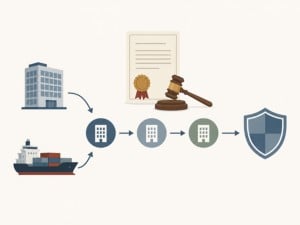
Winning an arbitration does not necessarily end a dispute. Where an award debtor refuses to pay and is alleged to have moved assets through foreign corporate structures, the real contest may begin only after the tribunal has rendered its decision. On 7 August 2026, the High Court of Justice, Commercial Court addressed the issue. The […]
French Court of Cassation Limits Enforcement Against State-Linked Assets Where EU Stability Objectives Are at Stake

On 17 June 2026, the First Civil Chamber of the French Cour de cassation (“Court of Cassation”) (English version of decision here) drew an important boundary around enforcement against assets of State-linked entities. The Court accepted the general French-law principle that a creditor of a foreign State may, in certain circumstances, enforce against assets held […]
Blasket v. Spain: Limits on Sovereign Asset Discovery

On 12 June 2026, Judge Beryl A. Howell of the United States District Court for the District of Columbia issued a post-judgment discovery order in Blasket Renewable Investments, LLC v. Kingdom of Spain, a long-running enforcement proceeding arising from an ICSID award against Spain. The decision matters because it confirms both the breadth and the […]
State Immunity and ICSID Awards: The UK Supreme Court Joins International Consensus on Enforcement

On 4 March 2026, the Supreme Court of the United Kingdom (the “Supreme Court”) held in Kingdom of Spain v Infrastructure Services Luxembourg S.À.R.L. and Republic of Zimbabwe v Border Timbers Ltd that Spain and Zimbabwe (the “States”) could not invoke state immunity to resist the registration in England of ICSID awards rendered against them. The […]
Devas v. Antrix: Dutch Enforcement and the Limits of Seat-Based Annulment

With the Dutch Supreme Court’s 6 March 2026 dismissal of Antrix’s cassation challenge, attention has once again turned to one of the most closely watched India-linked arbitration disputes in recent years. The dismissal leaves in place the Hague Court of Appeal’s 17 December 2024 judgment in Devas Multimedia America Inc. v. Antrix Corporation Ltd., permitting […]