
The ICC Dispute Resolution 2025 Statistics are more than an annual scorecard. They show a global, institutionally active arbitration system that is also becoming increasingly regional and efficiency-focused. Questions of diversity, procedure and award quality are also greatly influencing the arbitration system. Nowadays, the International Chamber of Commerce (“ICC”) represents the interests “of more than […]
Deepfakes in International Arbitration

Deepfakes may soon become a practical problem for international arbitration. Artificial intelligence (AI) has become increasingly integrated into arbitral procedure and decision-making, as discussed in a previous Aceris Law note on LaPaglia v. Valve. AI tools are frequently praised for their capacity to produce large volumes of text, images, audio and video within seconds. Yet […]
French Court of Cassation Limits Enforcement Against State-Linked Assets Where EU Stability Objectives Are at Stake

On 17 June 2026, the First Civil Chamber of the French Cour de cassation (“Court of Cassation”) (English version of decision here) drew an important boundary around enforcement against assets of State-linked entities. The Court accepted the general French-law principle that a creditor of a foreign State may, in certain circumstances, enforce against assets held […]
Ukraine v. Russia UNCLOS Award on Environment and Navigation
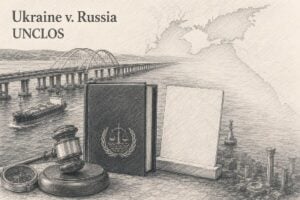
On 22 April 2026, an Annex VII arbitral tribunal issued its Award in Ukraine v. Russian Federation, a major law-of-the-sea arbitration concerning coastal State rights in the Black Sea, the Sea of Azov, and the Kerch Strait. The arbitration was brought under the United Nations Convention on the Law of the Sea (“UNCLOS”), with the […]
Russian Court Refuses Recognition and Enforcement of LCIA Awards Against RUSAL on Public Order Grounds

On 28 May 2026, the Arbitrazh Court of the Kaliningrad Region refused to recognise and enforce two LCIA awards rendered against RTI Limited (“RTI”) and International Company Public Joint Stock Company United Company RUSAL (“RUSAL”) in favour of OWH SE i.L. (“OWH”). The court rejected OWH’s procedural objections, holding that RUSAL, although a debtor under […]