The Indus Waters Treaty arbitration has become one of the most significant treaty arbitration developments of 2026. It is no longer only about dams, rivers or hydropower. It is a test of whether a State can put a treaty “in abeyance”, refuse to participate in arbitration and still avoid the legal consequences of an arbitral tribunal’s decision.
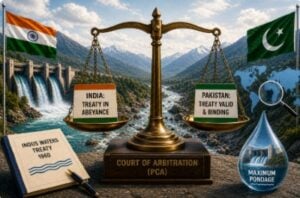 On 16 May 2026, India stated that the Court of Arbitration had issued, on 15 May 2026, what it described as an award concerning maximum pondage, a technical issue concerning how much water may be stored for run-of-river hydroelectric projects on the Western Rivers.[1] India rejected the award as “null and void”, maintained that the Court of Arbitration was “illegally constituted”, and reiterated that the Indus Waters Treaty remains in abeyance.[2] Pakistan, by contrast, had previously relied on the arbitration to argue that the Treaty remains valid, operational and binding.[3]
The dispute matters because it concerns the architecture of the India-Pakistan water-sharing regime. The 1960 Indus Waters Treaty allocates the Eastern Rivers to India and the Western Rivers, namely the Indus, Jhelum and Chenab, primarily to Pakistan, while allowing India limited uses, including hydropower generation subject to treaty constraints.[4]
The Treaty also contains a layered dispute-resolution system. “Questions” go first to the Permanent Indus Commission. Certain technical “differences” may go to a Neutral Expert. Certain unresolved “disputes” may be referred to a Court of Arbitration under Article IX and Annexure G.[5] That structure is now under pressure because India has favoured the Neutral Expert track, while Pakistan has pursued arbitration before the Court of Arbitration, with the Permanent Court of Arbitration acting as Secretariat to the Court of Arbitration.[6]
Non-Participation Is Not a Veto
The central question is simple: can a non-participating State stop an arbitration by rejecting the tribunal? The answer is usually no.
Non-participation may create political and enforcement difficulties, but it does not automatically deprive a tribunal of jurisdiction where the tribunal is satisfied that it has jurisdiction and that due process has been respected. The Permanent Court of Arbitration case docket is therefore more reliable than secondary news reports for tracking the procedural history. The Court of Arbitration has already issued an Award on Competence, a Supplemental Award on Competence, an Award on Issues of General Interpretation, and a Decision on Pakistan’s Request for Clarification, all listed on the PCA Case No. 2023-01 public docket.[7]
The June 2025 Supplemental Award is especially significant because the Court found that India’s position on “abeyance” did not limit the Court’s competence to proceed.[8] The Court also appears to have taken procedural legitimacy seriously. According to the Permanent Court of Arbitration’s press release, India did not participate, but the Court kept India informed, considered India’s objections from available materials, and tested Pakistan’s case rather than treating India’s absence as an automatic victory.[9]
Why Maximum Pondage Is More Than Engineering
The phrase maximum pondage sounds technical, but it is central to the future of transboundary water arbitration.
Pondage affects how a run-of-river hydropower plant stores and releases water. For India, storage capacity can affect power-generation flexibility. For Pakistan, upstream storage on the Western Rivers may raise concerns over timing and flow.
This makes the dispute more than an engineering disagreement. It is about how strictly treaty limits on hydropower projects must be interpreted when climate stress, electricity demand and national security concerns collide. Permanent Court of Arbitration materials, including the hearing presentation on pondage and subsequent case materials, show that pondage has been treated as a significant technical issue in the arbitration.[10]
The Neutral Expert Problem
The dispute also highlights a broader drafting lesson for water, energy and infrastructure treaties.
The World Bank has stated that the Neutral Expert process and the Court of Arbitration process are independent, and that the Treaty does not empower the World Bank to decide which process should take priority.[11] The Neutral Expert, Michel Lino, also issued a 2025 decision finding that he is competent to decide certain points of difference concerning the Kishenganga and Ratle hydroelectric plants.[12]
That creates a difficult procedural reality: two treaty mechanisms may operate in parallel, each claiming competence over different but overlapping aspects of the same hydropower dispute. For future treaties, the lesson is clear. If technical expert determination and arbitration are both available, the treaty should define sequencing, priority, preclusive effect and coordination with precision.
Why This Case Matters Beyond India and Pakistan
The Indus Waters Treaty arbitration is likely to be watched far beyond South Asia. Climate change, water scarcity and hydropower development are likely to make international water law disputes more frequent. States may also increasingly challenge arbitral tribunals as illegitimate rather than merely contesting jurisdiction within the proceedings.
The broader lesson is powerful: a State may reject a tribunal politically, but that does not make the tribunal disappear legally.
The Indus Waters Treaty was designed to keep water disputes from becoming security crises. The current arbitration asks whether that design can still work when the dispute is no longer only about rivers and dams, but also about the authority of international arbitration itself.
[1] Islamic Republic of Pakistan v. Republic of India, PCA Case No. 2023-01, reported Award concerning maximum pondage, 15 May 2026; A. Vishnoi, Indus river system: India rejects latest IWT Court ruling on water storage limits, Economic Times, 16 May 2026 (last accessed 19 May 2026).
[2] Express News Service, IWT: India rejects ‘so-called’ arbitration award as ‘null and void’, Indian Express, 17 May 2026 (last accessed 19 May 2026); Indo Asian News Service, “Null, Void”: India Rejects Hague Arbitration Ruling On Indus Waters Treaty, NDTV, 17 May 2026 (last accessed 19 May 2026).
[3] Ministry of Foreign Affairs, Government of Pakistan, Pakistan Welcomes the Supplemental Award Announced by the Court of Arbitration, 30 June 2025 (last accessed 19 May 2026); Ministry of Foreign Affairs, Government of Pakistan, Pakistan Welcomes the Award Rendered by the Court of Arbitration on the Issues of General Interpretation of the Indus Waters Treaty (IWT), 11 August 2025 (last accessed 19 May 2026).
[4] Indus Waters Treaty 1960, signed 19 September 1960, 419 UNTS 125, Arts. II-III and Annexure D.
[5] Indus Waters Treaty 1960, signed 19 September 1960, 419 UNTS 125, Art. IX and Annexures F-G; World Bank, Fact Sheet: The Indus Waters Treaty 1960 and the Role of the World Bank, 21 June 2023 (last accessed 19 May 2026).
[6] Permanent Court of Arbitration, Indus Waters Western Rivers Arbitration (Pakistan v. India), PCA Case No. 2023-01, case information and public docket (last accessed 19 May 2026).
[7] Islamic Republic of Pakistan v. Republic of India, PCA Case No. 2023-01, Award on the Competence of the Court, 6 July 2023; Islamic Republic of Pakistan v. Republic of India, PCA Case No. 2023-01, Supplemental Award on the Competence of the Court, 27 June 2025; Islamic Republic of Pakistan v. Republic of India, PCA Case No. 2023-01, Award on Issues of General Interpretation of the Indus Waters Treaty, 8 August 2025; Islamic Republic of Pakistan v. Republic of India, PCA Case No. 2023-01, Decision on Pakistan’s Request for Clarification of the Award on Issues of General Interpretation, 8 November 2025.
[8] Islamic Republic of Pakistan v. Republic of India, PCA Case No. 2023-01, Supplemental Award on the Competence of the Court, 27 June 2025; Permanent Court of Arbitration, The Court of Arbitration Renders a Supplemental Award on Competence, press release, 27 June 2025 (last accessed 19 May 2026).
[9] Permanent Court of Arbitration, The Court of Arbitration Renders an Award on Issues of General Interpretation of the Indus Waters Treaty, press release, 11 August 2025 (last accessed 19 May 2026).
[10] Permanent Court of Arbitration, Indus Waters Western Rivers Arbitration (Pakistan v. India), PCA Case No. 2023-01, case information and public docket (last accessed 19 May 2026); C. Miles, Hearing Presentation 15 – Pondage, 12 July 2024; Islamic Republic of Pakistan v. Republic of India, PCA Case No. 2023-01, Decision on Pakistan’s Request for Clarification of the Award on Issues of General Interpretation, 8 November 2025.
[11] World Bank, Fact Sheet: The Indus Waters Treaty 1960 and the Role of the World Bank, 21 June 2023 (last accessed 19 May 2026); World Bank, World Bank Makes Appointments Under the Indus Waters Treaty, 17 October 2022 (last accessed 19 May 2026).
[12] Permanent Court of Arbitration, PCA Case No. 2023-14: Neutral Expert Proceedings Under the Indus Waters Treaty (Republic of India v. Islamic Republic of Pakistan) – Neutral Expert Issues Decision on Certain Issues Pertaining to the Competence of the Neutral Expert, press release, 20 January 2025 (last accessed 19 May 2026); Permanent Court of Arbitration, Indus Waters Treaty Neutral Expert Proceedings (India v. Pakistan), PCA Case No. 2023-14, case information and public docket (last accessed 19 May 2026).