The taking of evidence in international arbitration can be a critical step in many international arbitrations.
Parties, or the arbitral tribunal, have often made recourse to the International Bar Association Rules on Taking of Evidence in International Arbitration (“IBA Rules”), whether the parties made an express choice for them to apply or not.
The IBA Rules were originally adopted in 1983 as the IBA Supplementary Rules Governing the Presentation and Reception of Evidence in International Commercial Arbitration. The first version of this set of rules was then revised in 1999, and then again in 2010. The main objective of the IBA Rules is to fill the gap between all different legal systems’ rules on the taking of evidence, and more specifically the gap between the civil law system and the common law one.
The IBA Rules have, nevertheless, been subject to criticism by civil law members of the arbitration community, who see in them a form of dominance of common law procedures in the taking of evidence. These criticisms led to the emergence of the Inquisitorial Rules on the Taking of Evidence in International Arbitration, also known as the Prague Rules.
The Prague Rules are a set of rules that are influenced by the civil law tradition and militate for an inquisitorial approach (contrary to an adversarial one that is defended by the common law system) in international arbitration. The drafters of the Prague Rules are convinced that they will contribute to the efficiency in international arbitration, as well as to reduce the time and costs of arbitration.
The Inquisitorial Approach of the Prague Rules
Contrary to the adversarial approach, the inquisitorial one militates for a proactive role of the arbitral tribunal. In other words, it rests on the distribution of burdens and powers between parties and the arbitral tribunal. Under this approach, the arbitral tribunal will take part in the fact-finding procedure, hence its proactive role. In the adversarial approach, the fact-finding procedure is handled by the parties. The arbitral tribunal has only the duty to preside over the procedure and to rule over the dispute, hence a more passive role.
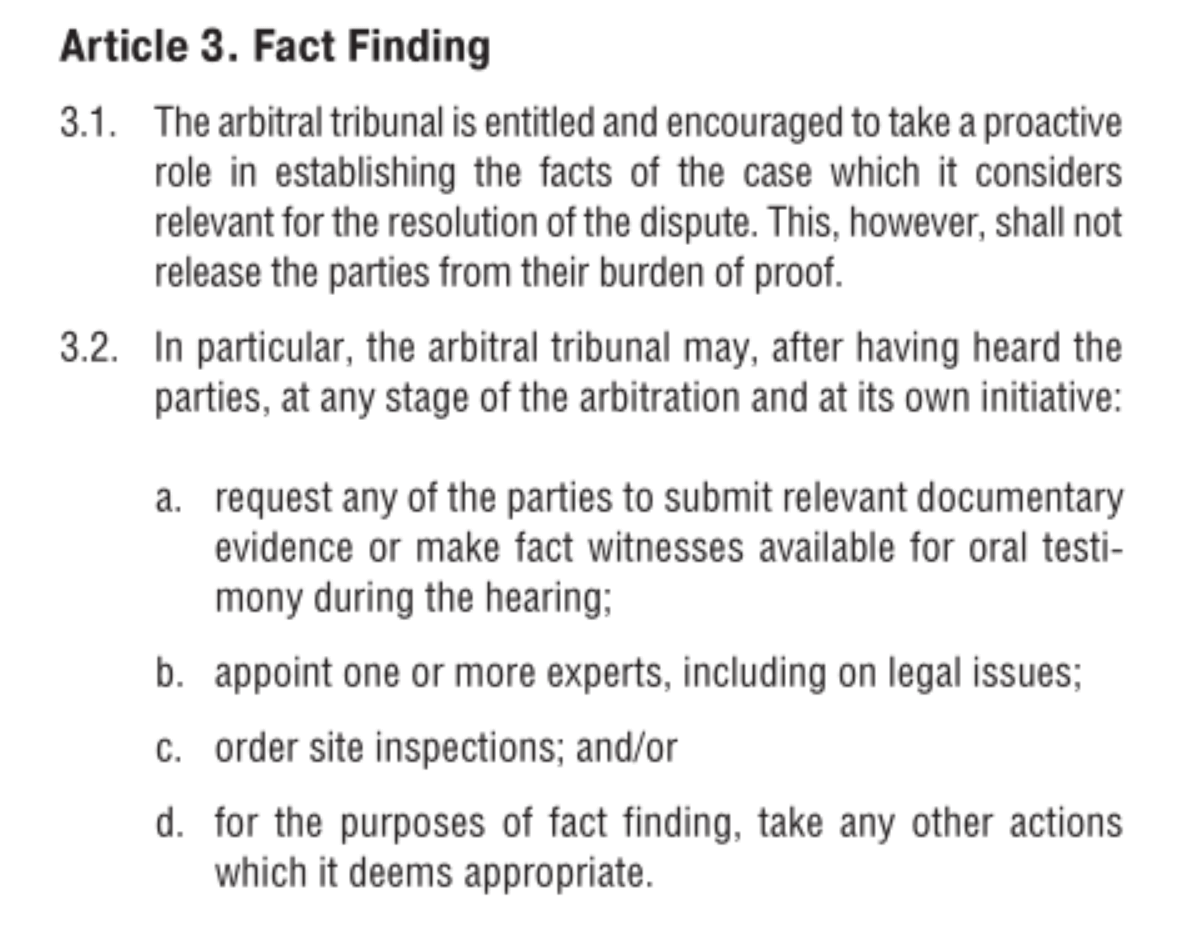
That said, the Prague Rules do not focus merely on the taking of evidence. Many provisions are linked to different topics: holding a case management conference by electronic communication, limiting the number of submissions or their length, amicable settlement, etc.
These other provisions may be useful in ad hoc arbitrations, but are unlikely to be useful in institutional ones, since most institutional rules already address such issues.
Sanam Pouyan, Aceris Law LLC