
Aceris Law is pleased to announce that its client, an Angolan State entity, has succeeded in winning the majority of its claims in an ad hoc UNCITRAL arbitration with its seat in Luanda, Republic of Angola. Its client was also awarded the majority of its costs for bringing the arbitration. The applicable law was Angolan […]
Coronavirus (COVID-19) and Courts: Moving from Litigation to Arbitration?

The global difficulties caused by the coronavirus (COVID-19), various State measures imposing restrictions on the movement of people, social distancing and complete lockdowns, while necessary to protect health, are inevitably having an impact on litigation in national courts, globally. In certain countries courts have had to limit, or to even entirely close, their operations due […]
Equal Treatment of the Parties in International Arbitration
Procedural protections consist of fundamental principles, which include the right to equal treatment and the right to be heard. Procedural protections are also provided through deference to party autonomy and the arbitrator’s procedural discretion.[1] The UNCITRAL Model Law, national arbitration legislation, judicial decisions and institutional rules provide for equality of treatment in various ways. Article […]
The Recovery of In-House Costs in UNCITRAL Arbitration
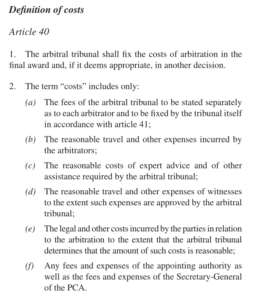
The 2010 UNCITRAL Rules (the “Rules”) provide for an exhaustive list of costs that may be considered by Arbitral Tribunals when ruling on costs.[1] Article 40 of the Rules provides that the recoverable costs of arbitration include legal and other costs incurred by the parties to the extent that the arbitral tribunal determines that these […]
Interim Measures in International Arbitration: A Need for Irreparable Harm?

It is a well-established rule of international arbitration that arbitral tribunals have the power to grant interim or conservatory measures. This is explicitly provided in all major arbitration rules (see, e.g., Article 28 of the 2017 ICC Rules, Article 25.1 of the 2014 LCIA Rules, Article 26 of the 2010 UNCITRAL Rules, Rule 30 of […]