
In 2008, Norscot Rig Management Pvt Limited (“Norscot”), the Claimant, successfully brought a claim in arbitration before the ICC in London, against Essar Oilfield Services Limited (“Essar”), the Respondent. The Arbitrator (Sir Philip Otton) held that the Respondent had breached an operation management agreement relating to an offshore drilling platform and thus was liable to pay over […]
Law of the Sea Award Rendered

In the dispute between the Republic of Malta and the Republic of São Tomé and Príncipe, the Tribunal issued on 5 September 2016 an award on its jurisdiction, admissibility of claims, liability and reparation, under the UN Convention on the Law of the Sea. The dispute relates first to the arrest of a vessel (the […]
ICC Emergency Arbitrator Rules
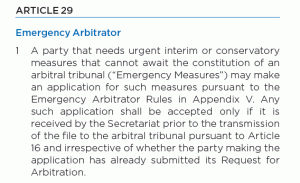
The 2012 ICC emergency arbitrator rules extend the advantages of arbitration to parties who are in urgent need of interim measures before an arbitral tribunal has been constituted. Before, parties had to seek such measures from State courts, which was not always possible or desired. An application for Emergency Measures can be filed prior to the Request for Arbitration under the ICC […]
Document Production under the LCIA Rules

Under Article 15 of LCIA Rules[1], parties only need to submit essential documents, which means identified documents that are relevant to the case and material to its outcome. This concept is common in international arbitration, but differs from English common law traditions, which require far more rigorous disclosure[2]. In order to encompass arbitration held both in common law […]
Escalation Clauses in the ICC Mediation Rules

On 1 January 2014, the Mediation Rules of the International Chamber of Commerce came into force (ICC Mediation Rules), thereby replacing ICC’s Amicable Dispute Resolution Rules. While arbitration under the ICC Arbitration Rules leads to a binding decision from an independent and neutral tribunal, the ICC Mediation procedure seeks to help the Parties reach a […]